
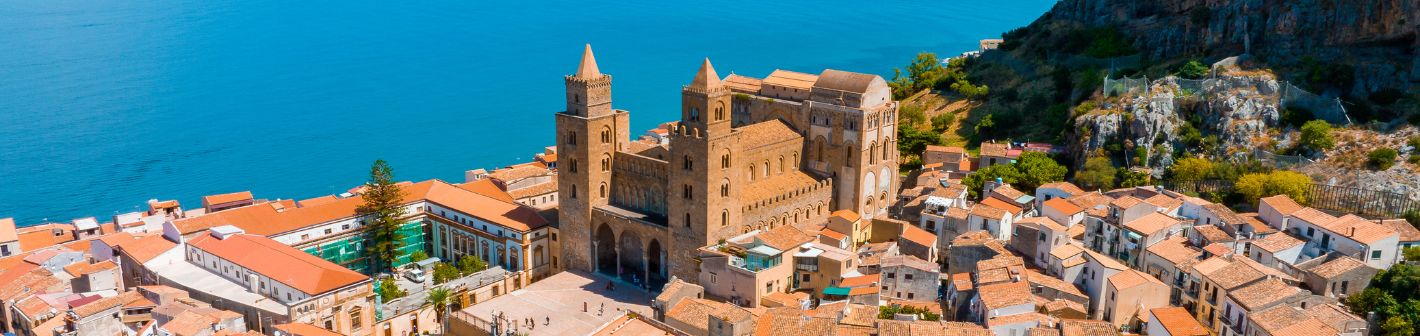
In short: Cefalù Cathedral is a 12th-century Norman cathedral whose two massive towers rise above the rooftops of the old town. Its centrepiece is the Byzantine Christ Pantocrator mosaic in the apse – the oldest of Sicily’s three great Norman Christ mosaics and a masterpiece of medieval gold-ground art. The cathedral has been part of the UNESCO World Heritage Site “Arab-Norman Palermo and the Cathedral Churches of Cefalù and Monreale” since 2015. The interior is freely accessible; the cloister, towers and roof are visited on paid tours. Allow around 30 to 60 minutes and combine your visit with a stroll through the old town and the town beach. From Palermo you can get there by train in just over 40 minutes.
Quick-Facts
- What: Norman cathedral (Cattedrale della Trasfigurazione), Basilica minor
- Location: Piazza del Duomo, old town of Cefalù (north coast, Province of Palermo)
- Built: from 1131 under King Roger II; apse mosaic 1145–1148; consecrated 1267
- UNESCO: World Heritage Site since 2015 (Arab-Norman Palermo, Cefalù and Monreale)
- Admission: church interior free; cloister from around €3; combined tower/roof tours are ticketed
- Opening: cathedral open daily, usually around 8:30am–1:00pm and 3:00pm–7:00pm (seasonal)
- Duration: around 30–60 minutes; combines well with the old town, beach and La Rocca
- Getting there: train from Palermo Centrale in just over 40 minutes; cathedral central, walkable
- Dress code: shoulders covered, no short trousers/skirts
History: Roger’s vow and the Norman cathedral
Cefalù Cathedral is a child of Sicily’s Norman golden age. King Roger II had it built starting in 1131 – according to legend, as thanks to God: in 1130 his ship is said to have been caught in a severe storm at sea off the north coast, and after a fortunate rescue on the shore at Cefalù, the king vowed to build a magnificent church. Whether a pious foundation or a show of political power on a strategically important coast, the cathedral was meant to be far more than a bishop’s church. Roger initially planned it as a burial place for the Norman dynasty and had two porphyry sarcophagi specially installed; his successor, however, moved the royal burial place to Palermo, so the king was ultimately not buried here.
The fortress-like twin-tower façade is characteristic, reading the building as both church and stronghold at once – typical of Norman Sicily, where Christian, Byzantine and Islamic building traditions merged into a style of their own. The precious apse mosaics were created from 1145 and completed around 1148; they rank among the earliest surviving examples of their kind on the island. The building itself took generations to complete: the cathedral was not officially consecrated until 1267. Over the centuries, Baroque additions were made and then removed again in the 20th century to reveal the austere Norman character. Since 2015, the cathedral has stood on the UNESCO World Heritage list together with buildings in Palermo and Monreale Cathedral, as an Arab-Norman ensemble.
What you’ll see
The overwhelming first sight on entering is the Christ Pantocrator in the half-dome of the apse. The over-life-size, blessing Christ on a luminous gold background appears both stern and gentle at once; in his left hand he holds an open Gospel book with Greek and Latin inscriptions. It’s the oldest of Sicily’s three great Norman Christ mosaics – predating those in Monreale and the Cappella Palatina in Palermo – and for many the most expressive. Below, Mary, archangels and apostles line up in several zones, executed by Byzantine masters in the finest tones of gold, blue and purple.
- Christ Pantocrator mosaic – the cathedral’s landmark in the apse (1145–1148), a high point of Byzantine mosaic art.
- Twin-tower façade – two powerful, slightly different towers above a 15th-century porch; the unmistakable image of Cefalù.
- Nave and columns – the tall, austere interior rests on ancient columns with Corinthian capitals; the exposed architecture underlines the Norman severity.
- Cloister (Chiostro canonicale) – a remnant of the medieval monastic courtyard with richly decorated paired columns and figurative capitals; a quiet contrast to the massive building.
- Towers and roof – accessible on paid tours, with views over the old town, the sea and the La Rocca cliff.
Tickets & opening hours
The church interior is freely accessible – so you can admire the Christ mosaic without a ticket. If you also want to visit the cloister, the towers or the museum/roof area, you’ll need a separate ticket; various tours of different scope are on offer. Payment is on site, and tickets are also available online. During religious services, tourist visits are restricted.
| Area | Access | Price (guideline) |
|---|---|---|
| Church interior (with Christ mosaic) | freely accessible | free |
| Cloister (Chiostro canonicale) | separate tour | from around €3 |
| Towers, roof & museum area | guided/ticketed route | ticketed, check on site |
Opening hours: the cathedral is generally open daily, usually from around 8:30am to 1:00pm and from 3:00pm to 7:00pm; exact times vary seasonally and with the schedule of services. The cloister has its own hours: from April to October usually daily 10:00am–1:00pm and 3:00pm–6:00pm, restricted in the winter months (November to March), often mornings on weekdays only. Since times, tours and prices change, check them before your visit on the official cathedral website or on site at the ticket desk.
Dress code: as in any active church, appropriate clothing applies – shoulders covered, no overly short trousers or skirts. Disposable scarves are available to buy at the bookshop by the entrance if needed.
Planning your visit
The cathedral sits on Piazza del Duomo in the middle of the old town, on one of Sicily’s most beautiful squares: framed by palm trees, street cafés and the steep La Rocca cliff rising behind it. 20 to 30 minutes is enough to see the interior with the mosaic; with the cloister and a tower tour it becomes just under an hour. The gold mosaic looks its best in the morning, when light falls through the apse windows – and before the midday tour groups arrive.
Cefalù makes an excellent day trip: combine the cathedral with a stroll through the lanes, the medieval washhouse (Lavatoio), the town beach right by the centre, and – with a bit of fitness – the climb up La Rocca for sweeping views over the coast and rooftops. Culturally, the visit combines well with the other Norman World Heritage sites, such as Monreale Cathedral and the Cappella Palatina near Palermo. You’ll find all the practical information on the town on our Cefalù page.
Getting there
Cefalù is one of the few destinations in Sicily that’s easy to reach without a car. From Palermo Centrale, regional and intercity trains cover the roughly 59 kilometres along the coast in about 40 to 47 minutes; during the day they run frequently, often every half hour. Cefalù station is just a few minutes’ walk from the old town and the cathedral – the route leads almost directly downhill towards Piazza del Duomo and the sea. For more on connections and the surrounding area, see our pages on Palermo and Cefalù.
By car, you can get there from Palermo via the A20 motorway in just over an hour. Note, though, that the old town is largely traffic-restricted (ZTL) – it’s best to park outside, for instance along the seafront promenade or near the station, and walk the last few minutes. Especially in high season, the train is the more relaxed choice.
Best time to visit
Visiting the cathedral itself is possible year-round, regardless of weather – the interior is cool and shaded. For the full Cefalù day trip with the old town, beach and La Rocca, spring (April to June) and autumn (September, October) are ideal: pleasant temperatures, clear light and fewer crowds than in high summer. In July and August, Cefalù is very lively as a beach resort; then early morning is worthwhile for the cathedral, before the day-trippers and the heat arrive. For a general overview, see Best time to visit Sicily.
Frequently Asked Questions
What makes Cefalù Cathedral special?
The Byzantine Christ Pantocrator mosaic in the apse (1145–1148) is considered the oldest of Sicily’s great Norman Christ mosaics. There’s also the striking Romanesque twin-tower façade that defines the townscape.
How much does it cost to enter the cathedral?
The church interior with the Christ mosaic is freely accessible. Separate, ticketed tours are available for the cloister, towers and the museum/roof area – the cloister from around €3. It’s best to check current prices on site.
What are the opening hours?
The cathedral is usually open daily, roughly 8:30am to 1:00pm and 3:00pm to 7:00pm; the cloister has its own, seasonally changing hours. Visits are restricted during religious services – check times in advance.
Is there a dress code?
Yes. As an active church, appropriate clothing applies: shoulders covered, no overly short trousers or skirts. Disposable scarves are available at the entrance if needed.
How do you get to Cefalù Cathedral?
Cefalù is reachable by train from Palermo Centrale in just over 40 minutes; trains run frequently during the day. The station is a few minutes’ walk from the old town, and the cathedral is centrally located and walkable.
How much time should you plan for?
20 to 30 minutes is enough for the interior with the mosaic; with the cloister and a tower tour it becomes just under an hour. Plan half a day to a full day for the whole town with the beach and La Rocca.
Is it worth visiting with children?
Yes – the cathedral visit is short, and the combination with the old town and a nearby sandy beach makes Cefalù family-friendly. The climb up La Rocca is an adventure for older children.
Our travel agency combines Cefalù with Palermo, Monreale and the Madonie region into a relaxed culture-and-coast trip – with hotels near the beach and suitable excursions. Just send us a no-obligation travel inquiry.
Send a travel inquiry nowSources & update
Based on: editorial local knowledge as well as publicly available information from the official cathedral website (duomocefalu.it) and the Consorzio Turistico Cefalù on opening hours, tours and dress code; historical key dates per Cefalù Cathedral (construction begun 1131, apse mosaic 1145–1148, consecration 1267). UNESCO World Heritage “Arab-Norman Palermo and the Cathedral Churches of Cefalù and Monreale” (2015). Train connection Palermo–Cefalù per Trenitalia timetable information. As of: 12 July 2026. Opening hours, tours and prices are subject to change and should be checked before your visit.

