
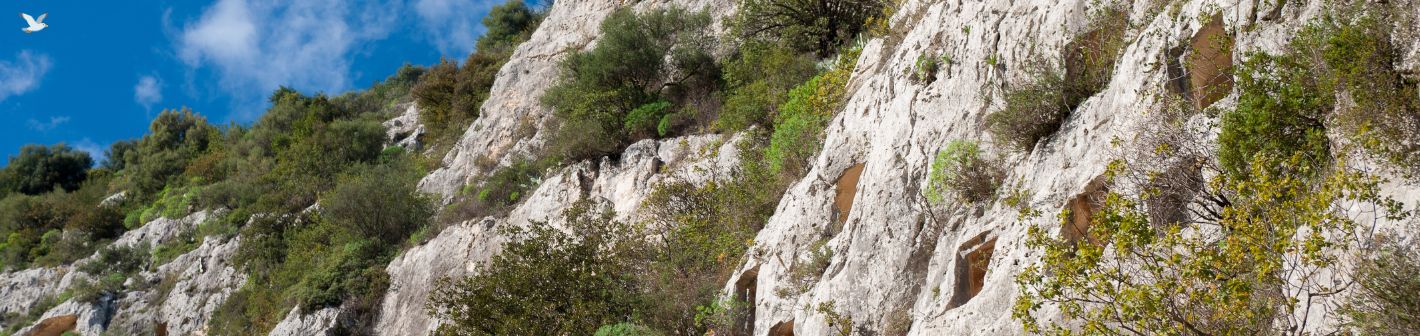
In short: The Pantalica Necropolis is one of the largest prehistoric burial sites in the Mediterranean: over 5,000 chamber tombs cut into the soft limestone rock (13th–7th century BC) line the deep gorges of the Anapo and Calcinara rivers between Ferla and Sortino. Since 2005, Pantalica has been a UNESCO World Heritage Site together with Syracuse. The site is also a nature reserve for hiking and swimming – freely accessible, but practically reachable only by car. Allow half a day to a full day.
Quick-Facts
- What: prehistoric rock-cut necropolis with over 5,000 chamber tombs in a gorge landscape
- Location: the Monti Iblei uplands between Ferla and Sortino, Province of Syracuse (southeast)
- Period: tombs mostly from the 13th–7th century BC; later Byzantine phase
- UNESCO: part of the World Heritage Site “Syracuse and the Rock Necropolis of Pantalica” (since 2005)
- Admission: freely accessible, no ticket – nature reserve
- Duration: half a day to a full day, depending on the hike
- Getting there: only practical by car; access points near Ferla and Sortino
- Bring: water, sun protection, sturdy shoes – little shade
History & significance
Pantalica was already an important place long before the Greek colonisation of Sicily. Between the 13th and 7th century BC, the native Sicels (Siculi) carved thousands of chamber tombs into the steep limestone walls above the river gorges. Over 5,000 of these honeycomb-like tomb chambers survive – a unique testament to a culture that held its ground up here, protected by the gorges of the Anapo and Calcinara, against the Greeks advancing from the coast. On the plateau, the so-called Anaktoron, a princely residence built from large stone blocks, recalls the settlement’s heyday.
Some researchers link Pantalica to the ancient Hybla, though the identification is not confirmed. After the founding of Syracuse (734 BC), the site lost significance. Only in the Byzantine and early medieval period (from around the 6th century AD) did life return: people made themselves at home in the old tomb chambers and built a rock-cut village. Several Byzantine chapels carved into the rock date from this era – such as the Oratory of San Micidiario – with traces of old frescoes. Since 2005, Pantalica has been on the UNESCO World Heritage list together with Syracuse, recognised as an outstanding testament to Mediterranean culture from prehistory into antiquity.
What you’ll see & hiking
The first impression is overwhelming: entire rock faces are riddled with countless dark openings – the entrances to the tomb chambers, spread across several large necropolis sections along the gorge (the Northwest, Filiporto, Cavetta and South necropolises). In between lie the Anaktoron and the Byzantine chapels. Much of it is unfenced but also barely signposted – Pantalica is a place to discover, not to tick off a checklist.
The second draw is the scenery. Pantalica is a nature reserve, and down in the Anapo Valley a comfortable, largely level path follows the route of a disused railway line through the green gorge. In places the river forms clear natural pools where you can swim on hot days – a welcome contrast to the shadeless plateau above. There are two access points: from Ferla in the west you reach the upper plateau with the Anaktoron and the large necropolises; from Sortino in the east you descend into the Anapo Valley. If you want to see both worlds, combine the plateau and the valley path – that easily fills a whole day. Sturdy shoes are essential, since the paths are sometimes steep and uneven.
Practical info: access, getting there & gear
Pantalica is practically only reachable by your own car; public transport connections are very limited. From Syracuse it’s around 45 to 60 minutes depending on the access point. There’s little infrastructure on site and patchy mobile signal in places – set off prepared accordingly.
| Topic | Situation | Recommendation |
|---|---|---|
| Admission | freely accessible, no ticket, no ticket booth | no reservation needed |
| West access | entrance near Ferla, upper plateau | for the Anaktoron & large necropolises |
| East access | entrance near Sortino, valley floor | for the Anapo Valley & railway route |
| Getting there | only practical by car | around 45–60 min from Syracuse |
| Gear | steep paths, little shade | sturdy shoes, water, sun protection |
| Swimming | natural pools in the Anapo river | only when water levels are safe |
Best time to visit
Ideal are spring (April to June) and autumn (September, October): pleasant temperatures and a green, sometimes flowering landscape. In high summer the gorges are hot with little shade – start early in the morning then and bring plenty of water. During prolonged heat and drought there can be a wildfire risk; paths may occasionally be closed, with official notices being authoritative. Pantalica combines well with Syracuse & Ortigia and the Neapolis Archaeological Park. For a general overview, see Best time to visit Sicily.
Frequently Asked Questions
What is the Pantalica Necropolis?
A prehistoric burial site with over 5,000 chamber tombs cut into the rock from the 13th–7th century BC, located in a gorge landscape between Ferla and Sortino. Since 2005 it has been a UNESCO World Heritage Site together with Syracuse.
Does Pantalica charge admission?
No. The site is freely accessible as a nature reserve; there’s no ticket booth like at a museum. Check parking arrangements and any on-site rules.
How do you get to Pantalica?
The most practical way is by car via the access points near Ferla or Sortino. From Syracuse it’s around 45–60 minutes. Public transport connections are very limited.
Can you hike and swim at Pantalica?
Yes. In the Anapo Valley a largely level path follows an old railway route through the gorge; the river forms natural pools in places for swimming. Sturdy shoes and enough water are important.
How much time should you plan for?
Half a day is enough for a first impression; a full day for longer hikes in the Anapo Valley and several necropolis sections.
When is the best time to visit?
Spring and autumn are the most pleasant. In high summer, start early, since the gorges are hot with little shade.
Our travel agency combines Pantalica with Syracuse, Noto and the Baroque southeast into a trip of antiquity, nature and Baroque architecture – with a rental car and suitable accommodation. Just send us a no-obligation travel inquiry.
Send a travel inquiry nowSources & update
Based on: editorial local knowledge as well as the UNESCO World Heritage List entry for the World Heritage Site “Syracuse and the Rock Necropolis of Pantalica”. As of: 13 July 2026. Accessibility, path conditions and possible closures (e.g. due to wildfire risk) are subject to change and should be checked before your visit.

