
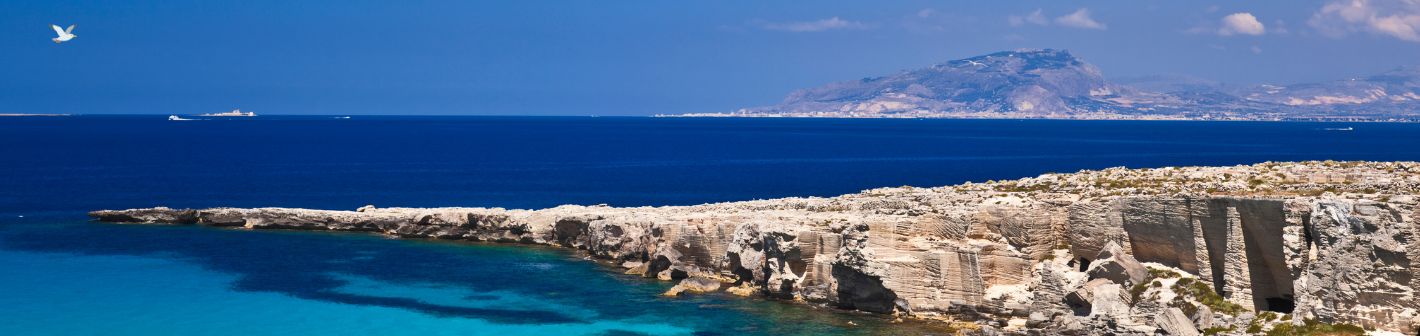
Favignana in one sentence: the largest and flattest of the Egadi Islands off Trapani – a bike- and swim-friendly island with brilliant turquoise coves such as Cala Rossa and an impressive tuna-fishing (tonnara) history. Ideal for beach, cycling and snorkelling trips; less so for sandy-beach purists and anyone seeking quiet in high summer. Plan for a day trip up to 1–3 nights. Best without a car – a bike is enough, and in summer vehicle traffic is closed to non-residents anyway.
Favignana is the butterfly-shaped heart of the Egadi Islands (Isole Egadi), just a short crossing west of Trapani. The island is flat, easy to get around and criss-crossed by a dense network of small lanes – ideal for cycling. There are hardly any sandy beaches; instead, tuff-stone and rocky coasts dominate the scenery – but the water has a clarity and colour you rarely see elsewhere.
Favignana is shaped by the history of tuna fishing. The former Tonnara Florio, once one of the largest tuna factories in the Mediterranean, is now a museum telling the story of the Mattanza – the old, ritualised tuna hunt that sustained the island for centuries. The old tuff-stone quarries, from which the region’s yellowish building material was extracted, form an unusual, sometimes garden-like green landscape.
Honestly, in July and August Favignana is no longer an insider tip. The boats from Trapani are often fully booked, the well-known coves are crowded, and shade is scarce on this largely treeless island. Anyone seeking quiet should come in June or September – that’s when the island shows its more relaxed side. Connections also depend on the weather; in strong wind, hydrofoils can be cancelled.
Quick facts
- Location largest of the Egadi Islands, off the west coast, Province of Trapani
- Length of stay a day trip is possible; nicer with 1–3 nights
- Getting around bicycle or e-bike ideal; scooter possible; a car is unnecessary
- Getting there Liberty Lines hydrofoil from Trapani (~30 min) or Marsala; car ferry (Siremar/Caronte) from Trapani
- Best time June & September quieter; July/August very crowded and hot
- Who it suits beach-goers, cyclists, snorkellers, those seeking quiet in the shoulder season
- Highlights Cala Rossa, Cala Azzurra, Lido Burrone, Ex Stabilimento Florio
- Note some coves are only accessible over rocks – water shoes recommended
Who is Favignana worth it for? (Decision helper)
| Traveller type | Well suited | Limitations |
|---|---|---|
| Swimming & snorkelling | crystal-clear, turquoise coves (Cala Rossa, Cala Azzurra) | often rocky/tuff coast rather than sand; access sometimes over rocks |
| Cycling | flat island, short distances, bike/e-bike rental on site | hot in high summer, little shade |
| Day trip | short crossing from Trapani (~30 min) | boats fully booked in summer – book early and secure the return trip |
| Families | Lido Burrone with sand/gravel and sunbed rental | popular coves fill up early in summer |
| With a car | — | only by ferry, not by hydrofoil; June–Sept. driving ban for non-residents |
Highlights & sights
Favignana’s appeal lies mainly in the water and in the tonnara history. The overview below ranks the main destinations – with an honest note on terrain and access, since many of the famous coves are not comfortable sandy beaches.
| Destination | Character | Note |
|---|---|---|
| Cala Rossa | tuff-stone walls, brilliant turquoise water – the iconic cove | access over rocks, no sand; water shoes; arrive early |
| Bue Marino | rocky/tuff coast with clear water, quieter | entry over rocks; sometimes only easily accessible by boat |
| Lido Burrone | the most family-friendly cove, with sand/gravel and sunbed rental | crowded in summer; good for the first swimming day |
| Cala Azzurra | shallow entry, pale blue water, close to town | popular, and correspondingly busy |
| Ex Stabilimento Florio delle Tonnare | former tuna factory, now a museum about the Mattanza | admission approx. –10–12, summer opening hours include evenings |
Prices, opening hours and accessibility of the coves are approximate (as of 17 June 2026) and should be checked before your visit. The coves have no fixed “opening hours”, but can already be crowded by mid-morning in high summer. The Tonnara museum has seasonally variable hours (sometimes until late evening in summer).
Highlights in detail
Cala Rossa
Cala Rossa, at the northeastern tip of the island, is Favignana’s best-known cove: tall walls shaped by old tuff-stone quarries that drop steeply into exceptionally clear, turquoise water. It is especially worthwhile for snorkelling and for the play of colour in the water on a windless day. Honest practical tip: there is no sand here, entry is over rocks and not entirely comfortable – water shoes are a good idea, and in high summer the cove is already full by mid-morning. More context in our overview: Beaches in Sicily.
Bue Marino
Bue Marino is another former quarry cove on the eastern side of the island, quieter and usually less visited than Cala Rossa, with equally clear water. Anyone wanting to avoid the biggest crowds and swim in peace is often better off here. Honest practical tip: here too the entry to the water is over rocks, and a sandy beach is nowhere to be found; some stretches are most comfortably reached by boat, for example as part of a round-the-island trip.
Lido Burrone
Lido Burrone, on the south coast, is the most family-friendly bathing spot on the island: a gently sloping beach of sand and gravel with a shallow entry, well suited for children and for a relaxed first day at the beach. There is a managed section with sunbed and umbrella rental as well as a freely accessible part. Honest practical tip: precisely because there is real sand here rather than rocks, the beach fills up quickly in summer – come early if you want space.
Cala Azzurra
Cala Azzurra lies close to the town in the southeast and offers a shallower, easier entry than the quarry coves, along with pale blue, calm water. That makes it a good choice for anyone wanting to enjoy the island’s play of colour without demanding rock scrambling. Honest practical tip: its proximity to town makes it popular and correspondingly busy; it is easy to reach by bike and combines well with a stop at nearby Cala Rossa.
Ex Stabilimento Florio delle Tonnare
The Ex Stabilimento Florio delle Tonnare in town is the restored former tuna factory of the Florio family and today the island’s most important museum. It uses machinery, photos and media stations to tell the story of tuna fishing and the Mattanza, which shaped Favignana for generations – a good contrast to swimming and ideal for the hottest hours, since you are indoors and cool. Honest practical tip: opening hours vary considerably by season, with some evening openings in summer – it’s worth checking the current hours before your visit.
The tonnara & the Mattanza
For centuries, Favignana lived off tuna. In early summer, bluefin tuna migrated from the Atlantic into the Mediterranean and were guided by a kilometres-long system of nets into the final “chamber of death” – a ritualised hunt, the Mattanza, accompanied by old work songs and led by the Rais, the fishing master. The tonnara, expanded by the Florio family from 1859, was one of the most productive in the Mediterranean. Industrial tuna fishing ended in the 1970s; the restored factory is now a museum well worth visiting.
Day plans
| Situation | Suggestion |
|---|---|
| Day trip | early boat from Trapani → rent a bike → Cala Rossa & Cala Azzurra in the morning → lunch in town → Lido Burrone → secure the return trip |
| Beach day by bike | ride clockwise along the coves on the quieter side of the island, don’t forget water shoes |
| In hot weather | coves early in the morning, shade/town at midday, the tonnara museum later (cool, indoors) |
| Two days | day 1: coves & cycling; day 2: tonnara, tuff-stone quarries and a boat trip to the remote calas |
Getting there
Hydrofoil: Liberty Lines connects Favignana several times daily with Trapani (around 30 minutes) and with Marsala. These fast boats do not carry vehicles. Car ferry: conventional ferries (Siremar or Caronte & Tourist) depart from Trapani and take longer (around 1 hour), but do carry vehicles. Important: from June to September, bringing or using a car on the island is generally banned for non-residents – so a car won’t get you anywhere anyway. Book tickets early in summer and be sure to secure your return crossing, since connections depend on the weather. If you want to combine several Egadi Islands, see our tips at Island Hopping in Sicily; a general overview of Getting to Sicily is available separately.
Getting around the island
The ideal way to get around is by bicycle: Favignana is flat, distances are short, and the town has numerous rental outlets (including e-bikes and scooters). This gets you to every cove comfortably in a few minutes to about half an hour. A car is unnecessary and in any case not permitted for non-residents in summer. Anyone who doesn’t want to cycle can reach the more remote calas by island bus, rented scooter, or organised boat tours.
Beaches & coves
Favignana’s coves are famous for their colour, not for wide sand. Cala Rossa, with its tuff-stone walls, is considered the most beautiful – but access is over rocks. Bue Marino is quieter and also rocky, Cala Azzurra has a shallower entry, and Lido Burrone is the most family-friendly cove, with sand/gravel and sunbeds. Water shoes are useful almost everywhere. More options and context in our overview: Beaches in Sicily.
Where to stay (areas)
- In town (Favignana paese): right in the centre, short distances to the harbour, restaurants and bike rental, lively in the evening – practical if arriving without a car.
- Outside town / towards the coves: quieter, more nature, ideal with a bike; less going on in the evening.
- Day visitor from Trapani/Marsala: anyone who just wants to swim can also stay on the mainland and cross over – but this costs time and flexibility.
Food & local specialities
Culinarily, much on Favignana revolves around tuna (tonno) – fresh, grilled, as a ragù, or preserved in bottarga and under oil. Typical of the Trapani region are hand-rolled busiate pasta, often served with tuna ragù or pesto alla trapanese. A simple, honest island classic is pane cunzato, the “seasoned bread” with tomato, anchovies or cheese, oregano and olive oil. We only give specific, vetted restaurant recommendations after editorial review – feel free to ask us during a consultation.
Day trips from Favignana
| Destination | Character | Suitability |
|---|---|---|
| Levanzo | smallest, quietest of the Egadi Islands; Grotta del Genovese with rock paintings | half-day/day trip by boat, very slow-paced |
| Marettimo | wildest, most mountainous Egadi island; hiking & diving | day trip, longer crossing – for nature lovers |
| Trapani | mainland port city, old town & salt pans | gateway, good for arrival/departure and a day in town |
| Marsala | wine town with salt pans and the Stagnone lagoon | from the mainland, alternative boat harbour |
Crossing times and schedules depend on the season, operator and weather, and should be checked in advance.
Common mistakes
- Arriving in high summer without reserved outbound and return tickets – the boats are often fully booked.
- Bringing a car even though a bike is enough and vehicles are banned for non-residents in summer anyway.
- Going to the rocky and tuff-stone coves without water shoes.
- Heading to the coves only around midday – the most beautiful calas are already full by then.
- Not reckoning with a possible ferry cancellation in windy conditions and planning the return journey too tightly.
Alternatives nearby
- Levanzo – the quietest Egadi island, perfect for slowing down.
- Marettimo – wild and mountainous, ideal for hiking and diving.
- San Vito Lo Capo – wide sandy beach on the mainland, if sand matters to you.
- Erice – medieval hill town above Trapani, as a change of pace.
Frequently asked questions (FAQ)
How do you get to Favignana?
The fastest way is the Liberty Lines hydrofoil from Trapani (around 30 minutes) or from Marsala. Anyone wanting to bring a vehicle needs the slower car ferry (Siremar/Caronte) from Trapani. Book tickets early in summer – connections depend on the weather.
Do you need a car on Favignana?
No. The island is flat and small – a bicycle or e-bike is entirely sufficient and the most pleasant way to reach the coves. From June to September, car traffic is banned for non-residents anyway.
Which cove is the most beautiful?
Cala Rossa, with its tuff-stone walls and turquoise water, is considered the most spectacular – but access is over rocks. Lido Burrone, with sand/gravel and sunbed rental, is more family-friendly. Water shoes are useful almost everywhere.
When is the best time to visit Favignana?
June and September are ideal: warm enough for swimming, but noticeably quieter than July and August, when the island is very crowded and the boats are often fully booked. More on this under “Best time to visit Sicily”.
Is Favignana suitable as a day trip?
Yes, thanks to the short crossing from Trapani. It’s nicer with one to three nights, especially to enjoy the coves in the morning before the daytime crowds arrive. Be sure to plan the return crossing firmly.
Plan your Favignana trip
Combine the Egadi Islands & western Sicily
Our travel agency combines Favignana with Trapani, Erice and Marsala – including ferries or hydrofoils, accommodation on the island, and excursions to Levanzo and Marettimo. Just send us a no-obligation trip request.
Further reading
- Province of Trapani · Trapani · Marsala · Erice
- Island Hopping in Sicily · Getting to Sicily
- Beaches in Sicily · Best time to visit Sicily
As of: 17 June 2026. Ferry schedules, vehicle rules, opening hours and prices are time-dependent and should be checked before travelling with the ferry operators (Liberty Lines, Siremar/Caronte & Tourist) or the museum. Sources: Comune di Favignana, Ex Stabilimento Florio delle Tonnare, Liberty Lines, Siremar/Caronte & Tourist. Weather data: Open-Meteo (CC-BY 4.0).

