
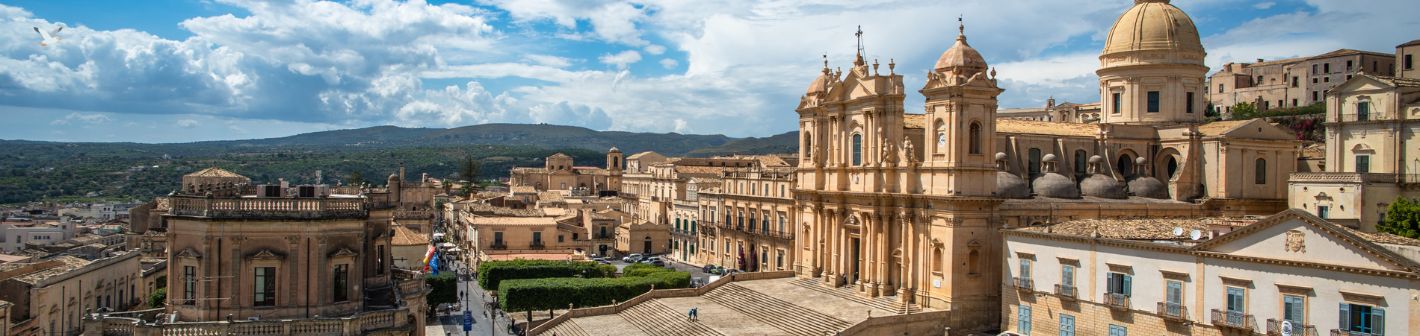
Noto in one sentence: the “capital of Sicilian baroque” in the southeast – rebuilt uniformly from honey-coloured stone after the 1693 earthquake and part of the UNESCO World Heritage Site Val di Noto. Ideal for culture, architecture and food travellers; less so for a beach holiday right on your doorstep. Plan half a day to a full day for the town, more as a base for the baroque southeast. The compact old town is explored on foot; in midsummer and during the Infiorata it’s very busy and hot.
Noto is Sicily’s most cohesive baroque ensemble. After the severe earthquake of 1693, the town was completely replanned a few kilometres from its original site and rebuilt in a single style. The result is an unusually uniform backdrop of pale, almost golden limestone, which today belongs to the UNESCO World Heritage Site “Late Baroque Towns of the Val di Noto”.
The centrepiece is the Corso Vittorio Emanuele: a broad, grand avenue lined with churches, palaces and squares. The Cathedral of San Nicolò sits enthroned above a wide flight of steps, and just a few steps away lies the Palazzo Nicolaci with its imaginatively carved balcony brackets. Much of it can be experienced from outside, while some interiors and viewpoints charge admission.
Honestly, Noto is fairly compact: the main sights lie close together and can be explored on foot in a few hours. The open main street offers little shade and is tiring at midday in midsummer; during the Infiorata in May the town is very crowded. Anyone combining the southeast with beaches, Vendicari and other baroque towns is best off using Noto as a base for several days.
Quick Facts
- Location southeastern Sicily, Province of Syracuse, inland near the coast
- Stay half a day to a full day for the town; longer as a base for the southeast
- Car not needed in the old town (compact, partly pedestrianised); useful for beaches/surroundings
- Getting there easiest by car; train/bus from Syracuse, from Catania with a change
- Best time spring & autumn; midsummer midday is very hot, little shade
- Suited for baroque, architecture, food, photography; less for pure beach time
- Highlights Corso Vittorio Emanuele, Cathedral of San Nicolò, Palazzo Nicolaci
- UNESCO Late Baroque Towns of the Val di Noto
Is Noto worthwhile? (decision guide)
| Traveller type | Well suited | Limitations |
|---|---|---|
| Culture & architecture | a cohesive baroque ensemble in a small area | hot at midday in midsummer – go early or in the evening |
| Food | cafes, granita, almonds, regional cuisine | tourist prices in the centre |
| Baroque road trip | a base for Modica, Ragusa, Scicli | the distances need a car |
| Without a car | old town on foot; connections to Syracuse | bus/train are infrequent; beaches are hard to reach |
| Families | short distances, ice cream and breaks | little “action”; plan for the heat |
Top sights (with time needed & admission)
The baroque centre is compact and easy to explore on foot. The table below gives the realistic time needed for each destination and, where applicable, the admission price.
| Sight | Time / admission | Tip |
|---|---|---|
| Cathedral of San Nicolò & the grand staircase | 20–30 min · church free | elaborately restored after the dome collapse of 1996; the staircase is a popular photo spot |
| Corso Vittorio Emanuele | 1–2 hrs · free | the central grand avenue with churches and palaces; the stone glows golden in the evening |
| Palazzo Nicolaci di Villadorata | 30–45 min · €5, with guided tour €7 | famous carved baroque balconies on the Via Corrado Nicolaci |
| Chiesa di San Carlo (bell tower climb) | 20–30 min · climb for a fee | a narrow climb up the church tower with views over Noto’s rooftops |
Admission prices and opening hours are indicative (as of 4 July 2026) and should be checked before your visit; individual churches and palaces change their hours seasonally. Around the Infiorata (the third weekend in May) the town is extremely crowded – the flower carpet on the Via Corrado Nicolaci usually requires an admission fee then.
The highlights in detail
Cathedral of San Nicolò & the grand staircase
The Cathedral of San Nicolò is Noto’s main church and stands raised above a wide, multi-tiered staircase on the Corso. It’s worth visiting mainly for this interplay of facade and staircase, which encapsulates the town’s baroque character; after the dome collapse of 1996 the building was elaborately restored. The staircase is a popular photo spot and correspondingly busy – early in the morning or late afternoon it’s less crowded, and the warm light shows off the pale stone far better than the midday sun.
Corso Vittorio Emanuele
The Corso Vittorio Emanuele is the old town’s central axis: a broad, grand avenue lined with churches, palaces and small squares. This is where the town’s cohesive appearance is best appreciated, since almost the entire ensemble is built from the same honey-coloured limestone. Honestly, the street offers little shade, which makes it tiring at midday in midsummer; the walk is most pleasant in the late afternoon and evening, when the stone glows golden.
Palazzo Nicolaci di Villadorata
The Palazzo Nicolaci lies just a few steps off the Corso on the Via Corrado Nicolaci and is known above all for its carved balcony brackets – grotesques, animals and figures support the wrought-iron balustrades. The palace is worth the short detour because it shows the playful attention to detail of the late baroque in a small space; part of the interior is open for a fee: €5 without a guide, €7 with a guided tour, open daily 10am–1pm and 3–7pm. During the Infiorata in May, this very alley is decorated with the flower carpet and gets very crowded.
Chiesa di San Carlo (bell tower climb)
The Chiesa di San Carlo on the Corso is one of the churches whose bell tower you can climb. The climb is worthwhile for the panoramic view over Noto’s rooftops and domes, which makes the town’s uniform baroque grid clearly visible from above. The way up is narrow and involves tight stairs – anyone uneasy with heights or carrying larger luggage should plan for that; in good weather the view extends into the surrounding countryside.
Noto on video
The following videos from external YouTube channels give a first impression of Noto and the Corso Vittorio Emanuele.
Day plans
| Situation | Suggestion |
|---|---|
| Half a day | Corso Vittorio Emanuele → Cathedral of San Nicolò → Palazzo Nicolaci |
| One day | Corso & cathedral in the morning, a cafe break/granita at midday, Palazzo Nicolaci and the San Carlo tower in the afternoon, the town in evening light |
| In the heat | a stroll early in the morning, a cafe break at midday, the Corso in the late afternoon/evening |
| With a beach | the town in the morning, Lido di Noto or Vendicari in the afternoon |
| With children | a short loop along the Corso, ice cream/granita, then the beach at Lido di Noto |
Getting there
Car: the simplest way to reach Noto is via the motorway from Catania towards Syracuse/Rosolini and then the main road; from Catania airport it’s around an hour and a half. Train: Noto lies on the regional Syracuse–Ragusa line; from Catania you change in Syracuse, and services are infrequent. Bus: AST and Interbus serve the Catania–Syracuse–Avola–Noto line; the journey from Catania takes around an hour and a half. In the town: the old town is compact and explored on foot. Overview: Getting to Sicily and Sicily by rental car (German).
Parking & ZTL
Parts of the historic centre are pedestrianised or subject to access restrictions (ZTL); for non-residents that means: park at the edge of the centre and continue on foot. Car parks lie below the old town and along the access roads, and fill up quickly in high season. Exact zones and times can change and should be checked before you travel. You don’t need a car for the town itself – it only becomes useful for beaches and the surrounding area. More on ZTLs and parking: Parking in Sicily (German).
Beaches & coast
Noto lies inland, but the coast is close by. The nearest seaside spot is Lido di Noto, with a sandy beach, lidos and free stretches, easily reached by car. To the south begins the Vendicari nature reserve with unspoiled coves, salt pans and birdwatching – swimming here happens in an undeveloped landscape, with footpaths and little infrastructure. More: Beaches in Sicily (German).
Where to stay (areas)
- Old town around the Corso Vittorio Emanuele: right in the centre of things, everything on foot, atmospheric in the evening – but more touristy and sometimes noisy.
- Edge of the old town / near the car parks: quieter, practical for arriving/departing by car.
- Towards the coast (Lido di Noto, Vendicari): as a base for the beach and excursions, with a car.
Food & enjoyment
The southeast is almond country: around Noto and nearby Avola grows the famous Avola almond, which finds its way into pastries and desserts. A specialty of the town is granita – semi-frozen ice, classically with brioche for breakfast; almond milk (latte di mandorla) is especially popular as a base. The long-established Caffè Sicilia on the Corso is considered by many to be the address for granita and almond pastries. Add to that regional cuisine and wine from the surrounding area (Nero d’Avola, Moscato di Noto). We only give specific, vetted restaurant recommendations after editorial review – feel free to ask us during a consultation.
Day trips from Noto
| Destination | Distance (approx.) | Suitability |
|---|---|---|
| Vendicari (nature reserve) | approx. 15–20 km | half day, coves, salt pans, birds; a car is useful |
| Marzamemi (tonnara fishing village) | approx. 25 km | half day, a square with restaurants, fish |
| Syracuse & Ortigia | approx. 40 km | day trip, by train or car |
| Modica & Ragusa Ibla | approx. 40–55 km | day trip, more baroque towns, best by car |
Travel times depend on traffic and season – don’t derive them from distance alone.
Common mistakes
- Visiting Noto in the midday heat – the open main street offers little shade.
- Planning only Noto and skipping Modica, Ragusa or Vendicari – the region rewards more time.
- Driving a rental car into the ZTL/pedestrian zone instead of parking at the edge.
- Relying on public transport for beaches and neighbouring towns – a car is far more practical here.
Alternatives nearby
- Modica (German) – a baroque town in a valley, famous for its chocolate.
- Ragusa Ibla (German) – another late baroque town of the Val di Noto.
- Syracuse & Ortigia – antiquity and baroque in the northeast of the province.
- Marzamemi (German) & Vendicari (German) – coast, fishing village and nature reserve in the south.
Frequently Asked Questions
How much time should you plan for Noto?
Half a day to a full day is enough for the old town. As a base for the southeast with Vendicari, Marzamemi and the baroque towns, it’s better to plan two to three days.
Can you visit Noto without a car?
The old town is explored on foot, and there are train and bus connections from Syracuse. For beaches and the surrounding baroque towns, though, a rental car or a guided tour is far more practical, since bus and train services are infrequent.
Why is Noto famous?
Noto was rebuilt uniformly in Sicilian late baroque style after the earthquake of 1693 and is considered its high point – the “capital of Sicilian baroque”. The old town belongs to the UNESCO World Heritage Site “Late Baroque Towns of the Val di Noto”.
When is the Infiorata in Noto?
The Infiorata traditionally takes place on the third weekend of May, when the Via Corrado Nicolaci is decorated with a large flower carpet. The town is very crowded then; exact dates and admission arrangements should be checked each year.
Are there beaches near Noto?
Yes. The Lido di Noto is the nearest sandy beach, and to the south lies the Vendicari nature reserve with unspoiled coves. Both are best reached by car.
Plan your Noto trip
Combine Noto with the baroque southeast
Our travel agency puts together a suitable route with a hotel in the right location, a rental car and well-planned stops covering Modica, Ragusa, Vendicari and Syracuse. Just send us a no-obligation travel enquiry.
Further reading
- Syracuse & Ortigia · Neapolis of Syracuse (German) · Modica (German) · Ragusa (German) · Province of Syracuse (German)
- Parking in Sicily (ZTL) (German) · Getting to Sicily · Sicily by rental car (German) · Best time to visit
- Beaches in Sicily (German) · UNESCO World Heritage (German)
- Weekly market in Noto (market day & opening hours) (German)
As of: 17 June 2026. Opening hours, admission prices, event dates (e.g. the Infiorata) and transport offerings are time-dependent and should be checked before your trip. Sources: Comune di Noto, UNESCO World Heritage Centre (Val di Noto), Infiorata di Noto, Trenitalia, AST/Interbus. Weather data: Open-Meteo (CC-BY 4.0).

