
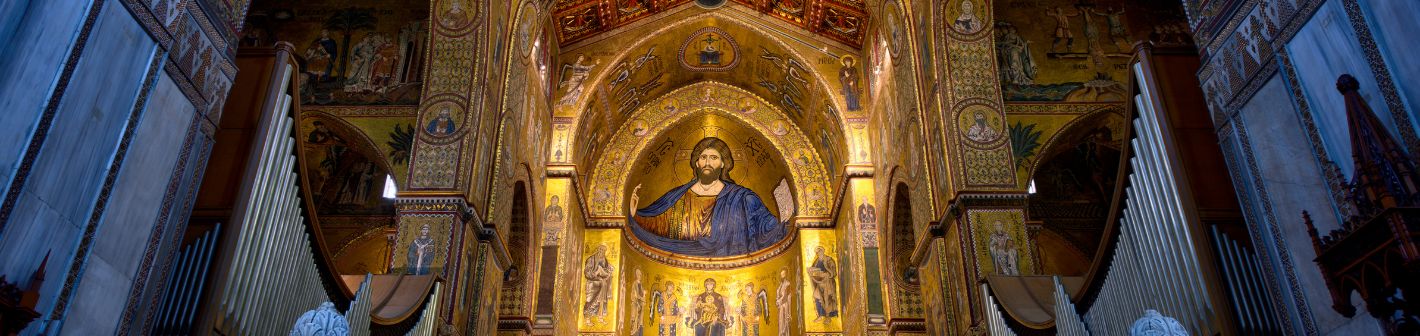
In short: Monreale Cathedral (Cattedrale di Santa Maria Nuova) above Palermo is one of the most impressive churches in Europe. Behind a plain façade lies around 6,300 m² of Byzantine gold mosaics, crowned by the monumental Christ Pantocrator in the apse. Right next door is the cloister of the former Benedictine monastery, with 228 finely carved columns. Together they’re a highlight of the UNESCO World Heritage Site “Arab-Norman Palermo” and make for a great half-day trip from Palermo. Allow one to two hours for the cathedral and cloister.
Quick-Facts
- Status: UNESCO World Heritage Site since 2015 (“Arab-Norman Palermo and the Cathedral Churches of Cefalù and Monreale”)
- Location: Monreale, on the slope of Monte Caputo, around 8 km southwest of Palermo
- Built: from 1174 under the Norman king William II
- Admission: cathedral €6, cloister €6, combined ticket €12 (as of 2026, check in advance)
- Highlights: gold mosaics with Christ Pantocrator, cloister with 228 columns, rooftop terraces overlooking the Conca d’Oro
- Duration: 1–2 hours for the cathedral and cloister; a half-day with travel to and from Palermo
- Getting there: city bus from Palermo, car, or a guided tour; narrow lanes in town
History: William II and the gold mosaics
Construction of the cathedral began in 1174 at the instigation of the Norman king William II (Guglielmo II, known as “il Buono”, the Good). Legend has it the Virgin Mary appeared to the young king in a dream and revealed the location of a hidden treasure, which he used to build the church. The political background is more concrete: with his own royal cathedral and an attached Benedictine monastery, William created a spiritual power base to rival the mighty Archbishop of Palermo. By around 1182, Monreale had already been elevated to an archbishopric.
In a remarkably short time – essentially by the 1180s – the vast mosaic surfaces that still define the interior today were created. They’re a prime example of the Arab-Norman style: Byzantine imagery and gold backgrounds, Romanesque-Norman architecture, and Islamic ornamentation and craftsmanship merge into a unity that only the multicultural Sicily of the 12th century could produce. The cathedral survived the centuries largely undamaged and has been part of the UNESCO World Heritage Site, together with other Norman buildings in Palermo and the cathedrals of Cefalù and Monreale, since 2015.
What you’ll see
- The mosaic cycle – around 6,300 m² of gold-ground mosaics cover the walls and vaults; it’s one of the most extensive surviving Byzantine mosaic cycles of the Middle Ages. Against a golden background, the images tell stories from the Old and New Testament in clear sequence – from the Creation through Noah to the life and works of Christ. You can “read” the church like an open picture book.
- Christ Pantocrator – the cathedral’s most famous image: an oversized, blessing Christ enthroned in the half-dome of the main apse, whose gaze dominates the entire church interior. Below are rows of Mary with Child, angels and saints. The depiction is considered one of the most impressive of its kind.
- Royal tombs and bronze portal – inside stand the sarcophagi of the Norman kings William I and William II. The main portal is closed by a signed bronze door by Bonanno Pisano (1186) with numerous relief scenes; a second bronze portal is by Barisano da Trani.
- The cloister (Chiostro) – right next to the cathedral lies the square cloister of the former Benedictine monastery. 228 slender columns, arranged in pairs, carry pointed arches; many capitals are individually designed and decorated with finely carved scenes. In one corner is a small, Arab-looking fountain courtyard. The cloister is managed separately and is usually paid for separately.
- The rooftop terraces – a narrow staircase leads up to the terraces above the side aisles. From here the view stretches over the roofs of Monreale, the fertile plain of the Conca d’Oro, and out to the sea near Palermo. The climb is worthwhile but requires a good head for heights.
Tickets & opening hours
The cathedral itself is an active parish church; a ticket is required for the tourist visit of the nave, the Cappella Roano, the Museo Diocesano and the rooftop terraces. The cloister is managed separately and paid for separately. If you want to see everything, the combined ticket is the cheapest option. Prices are paid in cash or by card at the ticket offices; buying online in advance is recommended.
| Ticket | Price | Includes |
|---|---|---|
| Cathedral (Duomo) | €6 | nave, Cappella Roano, rooftop terraces, exhibition halls, Museo Diocesano |
| Cloister (Chiostro dei Benedettini) | €6 | cloister only |
| Combined ticket “Complesso Monumentale” | €12 | cathedral + cloister + rooftop terraces + museum |
Opening hours differ by area. The cloister is generally open Monday to Saturday from 9:00am to 7:00pm, and Sundays and holidays from 9:00am to 1:30pm. The cathedral, Museo Diocesano, Cappella Roano and rooftop terraces are usually accessible Monday to Saturday from 9:00am to 1:00pm and 2:30pm to 4:30pm, and on Sundays (cathedral only) from 2:30pm to 4:30pm. Last admission is roughly 15 to 30 minutes before closing. During Mass, weddings and funerals, visiting is restricted – especially on Sunday mornings. Since prices and times can change, check them with the official visitor management before your visit.
Planning your visit
It’s best to start in the cathedral, while the morning light makes the mosaics glow, and take your time viewing the picture cycle from the entrance wall through to the apse. The cloister is then worthwhile as a quiet, artistically distinct contrast – skipping it would be a shame. If you’re comfortable with heights, finish with the rooftop terraces. Just under an hour is enough for the church alone; with the cloister, terraces and museum it becomes two hours.
Note the dress code: as is customary in Italian churches, shoulders and knees should be covered, or entry can be refused. A light scarf is enough. A common mistake is scheduling the visit for early afternoon, when parts of the complex are closed for the midday break. Monreale combines well with a morning in Palermo and other stops on the Arab-Norman heritage trail, such as the Cappella Palatina or Cefalù Cathedral. More on the town itself under Monreale.
Getting there
It’s only about 8 km from Palermo. The simplest way is by city bus: AMAT line 389 connects Piazza Indipendenza (close to the Norman Palace) with the centre of Monreale in a good half hour. By car, the uphill drive takes around 20 to 30 minutes; however, the lanes in town are narrow and parking is scarce, so it’s advisable to park on the edge of town and continue on foot. Many travellers therefore choose the bus or a guided half-day tour from Palermo that bundles transport and admission. General information can be found under Palermo and Car rental in Sicily.
Best time to visit
The cathedral can be visited year-round, since the real attraction lies in the cool interior. The most pleasant times are spring (April to June) and autumn (September, October): mild weather for the climb up to the terraces and the stroll through Monreale, without Palermo’s summer heat. In high summer, early morning is the best choice – ahead of the tour groups and before the midday break closes parts of the complex. For a general overview, see Best time to visit Sicily.
Frequently Asked Questions
How much does admission to Monreale Cathedral cost?
Admission to the cathedral costs €6 and includes the Cappella Roano, rooftop terraces and Museo Diocesano. The cloister costs a separate €6; a combined ticket for the whole complex is €12 (as of 2026, check in advance).
What are the opening hours?
The cloister is generally open Monday to Saturday 9:00am–7:00pm and Sundays 9:00am–1:30pm. The cathedral, museum, Cappella Roano and terraces are accessible Monday to Saturday 9:00am–1:00pm and 2:30pm–4:30pm, and on Sundays (cathedral only) 2:30pm–4:30pm. Visiting is restricted during Mass; check times in advance.
Does the cloister cost extra?
Generally yes. The cathedral and cloister are managed and priced separately. If you want to see both plus the rooftop terraces and museum, the combined ticket at €12 is the cheapest option.
Can you go up to the rooftop terraces?
Yes. A narrow staircase leads to the rooftop terraces with sweeping views over Monreale, the Conca d’Oro, and out to the sea. Access is included in the cathedral ticket, but requires a good head for heights.
What dress code applies?
As is customary in Italian churches, shoulders and knees should be covered. A light scarf is enough to cover shoulders or legs if needed; otherwise entry can be refused.
How do you get from Palermo to Monreale?
The simplest way is the AMAT city bus 389 from Piazza Indipendenza (around 30 minutes) or by car (20–30 minutes). Because of narrow lanes and scarce parking, the bus or a guided tour is often the more comfortable choice.
How much time should you plan for?
About one to two hours for the cathedral and cloister. With travel to and from Palermo it becomes a half-day trip.
Our travel agency combines Palermo, Monreale and Cefalù into a well-rounded cultural trip – with suitable hotels, transfers or a rental car, and guided visits. Just send us a no-obligation travel inquiry.
Send a travel inquiry nowSources & update
Based on: editorial local knowledge as well as publicly available information from the visitor management of the Complesso Monumentale di Monreale (Duomo, Chiostro, Terrazze) and UNESCO on prices, opening hours and building history. UNESCO World Heritage “Arab-Norman Palermo and the Cathedral Churches of Cefalù and Monreale” (since 2015). As of: 12 July 2026. Admission prices and opening hours are subject to change and should be checked before your visit.

