
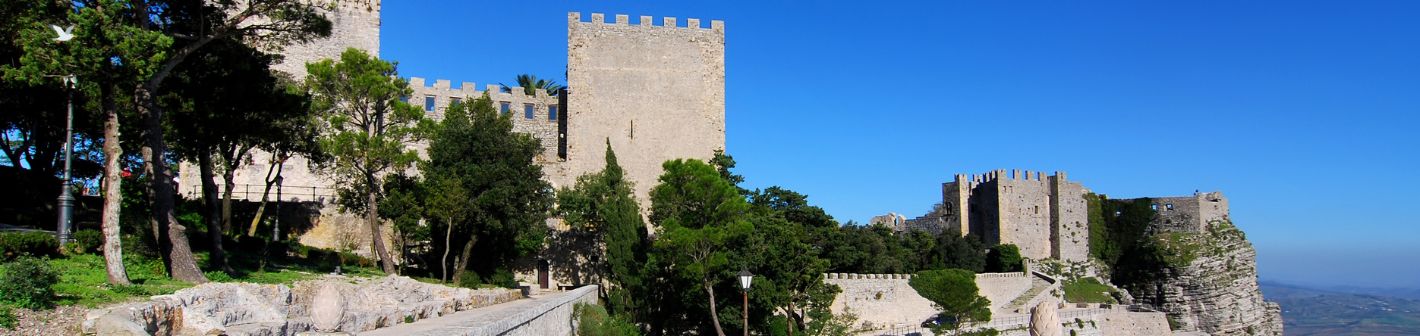
Erice in one sentence: a medieval hill town around 750 m above Trapani – a tight-knit old town of grey stone, a Norman castle, the Real Duomo with a climbable bell tower and, on clear days, sweeping views over the salt pans, the sea and the Egadi Islands. A classic half-day destination for culture, food and view-seeking travellers; less suited to a beach or nightlife holiday. Up top it is noticeably cooler and often foggy – on overcast days the view disappears. Access is by the cable car from Trapani or by car via a winding mountain road; a ZTL applies in the old town.
Erice sits on Monte Erice, a mountain ridge around 750 metres above Trapani on the west coast of Sicily. The little town has survived almost entirely medieval: grey stone houses, a triangular network of lanes, small inner courtyards and two castles on the exposed eastern edge. Because of its height above the sea, clouds often gather around the mountain – on some days this gives Erice an almost Nordic, misty mood, but it can also swallow the whole view.
Half a day is enough for the old town and the main sights. Erice combines well with Trapani, the salt pans and Segesta into a western Sicily day. If you’re short on time, the best approach is to take the cable car up, walk the lanes, climb the castle or the bell tower and try the famous almond pastries. In high summer the old town is full of day-trippers during the day; in the evening it becomes quiet, and the choice of restaurants is limited.
Quick facts
- Location on Monte Erice (around 750 m) above Trapani, Province of Trapani
- Length of stay half a day for the old town and the castle
- Getting there cable car from Trapani, or a winding mountain road by car
- Car not needed in the old town (ZTL); park outside the gates
- Best time spring & autumn; a clear day for the views
- Good for culture, food (almond pastries), views; not for beach/nightlife
- Highlights Castello di Venere, Real Duomo & bell tower, the lanes, Quartiere Spagnolo
- Note cooler, windier and often foggy up top – bring a jacket
Who is Erice worth it for? (Decision helper)
| Travel type | Good for | Limitations |
|---|---|---|
| Culture & the Middle Ages | a tight-knit old town, a Norman castle, churches | a lot of cobblestones and slopes |
| Views | panorama over the salt pans, the sea and the Egadi Islands | often no view in fog or cloud |
| Food | famous almond pastries (Genovesi, Dolci ericini) | few places open in the evening |
| Without a car | cable car from Trapani, then everything on foot | the cable car depends on weather and maintenance |
| Families | cable car ride, the castle, ice cream/pastries | cobblestones and steps are hard work with a pushchair |
Top sights (with time needed & admission)
The old town is compact and walkable, but hilly. The overview below gives a realistic time needed for each destination and, where applicable, the admission price.
| Destination | Time / admission | Tip |
|---|---|---|
| Castello di Venere & Giardino del Balio | 45–60 min · single ticket €5, Erice Card (further cultural sites such as Quartiere Spagnolo, Torretta Pepoli) €16, reduced €10 | the best all-round view; the adjoining park is free to enter |
| Chiesa Matrice (Real Duomo) | 20–30 min · around €2.50 | the Gothic main church by the Porta Trapani |
| Campanile (bell tower) | 20–30 min · around €2.50 | 110 steps, ~28 m; views as far as Marsala and Segesta |
| Quartiere Spagnolo | 20–30 min · free | ruins on a rock platform, one of the finest viewpoints |
| Old town lanes | 1–1.5 hrs · free | a triangular network of lanes, courtyards, ceramics & rugs |
Admission prices and opening hours are indicative (as of 4 July 2026) and should be checked before your visit. Opening hours at the cultural sites vary seasonally (longer in summer, sometimes by prior booking only in winter). There is a discounted combined ticket for the castle, the Duomo, the bell tower and the Quartiere Spagnolo.
The highlights in detail
Castello di Venere & Giardino del Balio
The Castello di Venere is a 12th-century Norman castle built on the foundations of an ancient sanctuary of Venus, at the outermost rocky spur of Erice. It is the town’s most striking building and offers the widest all-round view from its viewpoint over the west coast, the salt pans and, on clear days, as far as the Egadi Islands. The adjoining Giardino del Balio, a park laid out in the 19th century with towers and viewing terraces, is free to enter and a good option if you only want to see the castle from the outside. Practical tip: this is exactly where the weather has the biggest effect – in fog or low cloud, little remains of the view, so the climb is especially worthwhile on clear days.
Real Duomo & the bell tower
The Chiesa Matrice, also known as the Real Duomo, is the Gothic main church of Erice and stands just behind the Porta Trapani at the town entrance. Worth seeing are the pointed-arch portal, the porch and the interior, redesigned in Neo-Gothic style in the 19th century. The freestanding Campanile was originally a watchtower and can be climbed via around 110 steps; from the top, on good weather days, the view reaches as far as Marsala and Segesta. Practical tip: the climb is narrow and steep, and the tight spiral staircase requires some sure-footedness; on windy days the platform is exposed and cool.
Quartiere Spagnolo & viewpoints
The Quartiere Spagnolo is a never-completed 17th-century barracks building that today lies in ruins on a rock platform at the northern edge of the old town. Access is free, and the platform is one of the town’s best viewpoints – from here you look out over the Golfo di Bonagia and the north coast, while the Giardino del Balio shows more of the southern side with Trapani and the salt pans. Practical tip: since the location is open and unsheltered, it is especially windy and cool here – a jacket is worthwhile even in summer, and in fog the long view disappears here too.
Old town lanes
Erice’s old town is laid out around a triangular network of grey-stone lanes, with cobblestones, small inner courtyards and ever-surprising glimpses of the sea and surrounding countryside. Between the Porta Trapani and the main square, workshops and shops selling local ceramics and hand-woven rugs line up alongside the pasticcerie with their typical almond pastries. A stroll with no fixed destination is really the point here and belongs to every visit. Practical tip: the paving is smooth and sometimes steep, so sturdy shoes are advisable; many lanes are hard going with a pushchair or a walker. Coming up, you start on foot conveniently from the cable car’s upper station; the harbour town at the foot of the mountain is Trapani.
Getting there
Cable car: the most atmospheric way up is the cable car from the edge of Trapani – it climbs over 700 metres of elevation in around ten minutes, with views of the town, the salt pans and the Egadi Islands. Cabins run continuously, about once a minute. Important: on Mondays service does not start until the early afternoon due to maintenance, and in strong wind the cable car is suspended at short notice. In late autumn and winter (roughly November, and January to the end of March) service is sometimes suspended entirely. Fares were last raised in early 2026 (as of 4 July 2026: €9 one way, €15 return for standard tickets; reduced fares for residents and children’s groups, among others) – check the current price and timetable in advance on the official website. Car: alternatively, a winding mountain road leads up; car parks are located outside the gates of the old town. Overview: Getting to Sicily and Sicily by rental car.
Parking & ZTL
The old town of Erice is largely car-free and has a ZTL (restricted traffic zone). For day visitors this means: park in the car parks outside the town gates and continue on foot – which suits the town anyway, since the lanes can only be explored on foot. Anyone arriving by cable car needs no car in Erice at all. The exact zones and times can change, so check before your trip. More on ZTL and parking: Parking in Sicily.
Food & wine
Erice is known well beyond Sicily for its almond pastries, which go back to a monastic tradition. Typical are Genovesi (shortcrust pastries with a warm cream filling), almond confections and marzipan fruits (Frutta martorana). A well-known institution is the pasticceria of Maria Grammatico, who learned the confectioner’s craft as a child in the convent – it’s best to check locally whether and in what form it’s open. In the evening the choice of restaurants is small; many places focus on daytime trade. We only give concrete, vetted restaurant recommendations after editorial review – feel free to ask us during a consultation.
Day trips from Erice
| Destination | Distance (approx.) | Suitability |
|---|---|---|
| Trapani & the salt pans | around 15 km (cable car/car) | half a day, combines well with Erice |
| Segesta (temple & theatre) | around 35 km | half a day, best by car |
| San Vito Lo Capo | around 45 km | day trip, beach & tonnara |
| Marsala (wine & salt pans) | around 45 km | a day or half a day, by car |
Travel times depend on traffic and season – do not calculate them from distance alone.
Common mistakes
- Going up under an overcast sky and being disappointed that the view is missing – check the weather beforehand.
- Counting on the cable car on Monday morning, when maintenance means it doesn’t run until the afternoon.
- Coming without a jacket – up top it is noticeably cooler and windier than on the coast.
- Walking the smooth cobblestones in unsuitable footwear.
- Arriving at midday in high summer, when the lanes are full of day-trippers.
Erice on video
The following videos from external YouTube channels give a first impression of Erice – from the cable car ride to walks through the old town.
Alternatives nearby
- Trapani – the harbour town at the foot of the mountain, the starting point for the cable car and the salt pans.
- San Vito Lo Capo – a broad sandy beach and a tonnara, good for a beach day.
- Marsala – a wine town with salt pans and the island of Mozia.
- Favignana – the largest of the Egadi Islands, by ferry from Trapani.
Frequently asked questions (FAQ)
How do you get to Erice?
The most atmospheric way is the cable car from Trapani – around ten minutes’ ride. Alternatively, by car via the winding mountain road. The cable car runs depending on weather and maintenance; on Mondays it does not start until the early afternoon.
How much time should you plan for Erice?
Half a day is enough for the old town, the castle and an almond pastry. Combined with Trapani and the salt pans, it becomes a full western Sicily day.
Why is it often foggy in Erice?
Because of its exposed position high above the sea, clouds often gather around the mountain. This gives Erice a distinctive mood, but can severely limit the long views.
What does admission to the castle and the Duomo cost?
Indicative: Castello di Venere single ticket €5, the Real Duomo and the bell tower around €2.50 each. For several sites (the castle, Museo Cordici, Quartiere Spagnolo, Torretta Pepoli and others) there is the Erice Card for €16, reduced €10. Prices and opening hours change seasonally – check in advance.
What is Erice known for in terms of food?
For its almond pastries rooted in a monastic tradition, above all the Genovesi with a warm cream filling, plus almond confections and marzipan fruits. A well-known address is the pasticceria of Maria Grammatico.
Plan your Erice trip
Combine Erice with Trapani, the salt pans & the west
Our travel agency combines Erice with Trapani, the salt pans, Segesta, San Vito Lo Capo and Marsala into a varied western Sicily trip – with a hotel in the right location, a rental car and excursions. Just send us a no-obligation travel enquiry.
Further reading
- Province of Trapani · Trapani · Marsala · San Vito Lo Capo · Favignana
- Parking in Sicily (ZTL) · Getting to Sicily · Sicily by rental car
- Best time to visit Sicily
As of: 4 July 2026. Opening hours, admission prices and cable car service are time-sensitive and should be checked before your trip. Sources: Città di Erice, Fondazione Erice Arte (Castello di Venere, Real Duomo & bell tower), Funivia Trapani–Erice (Funierice). Weather data: Open-Meteo (CC-BY 4.0).

