
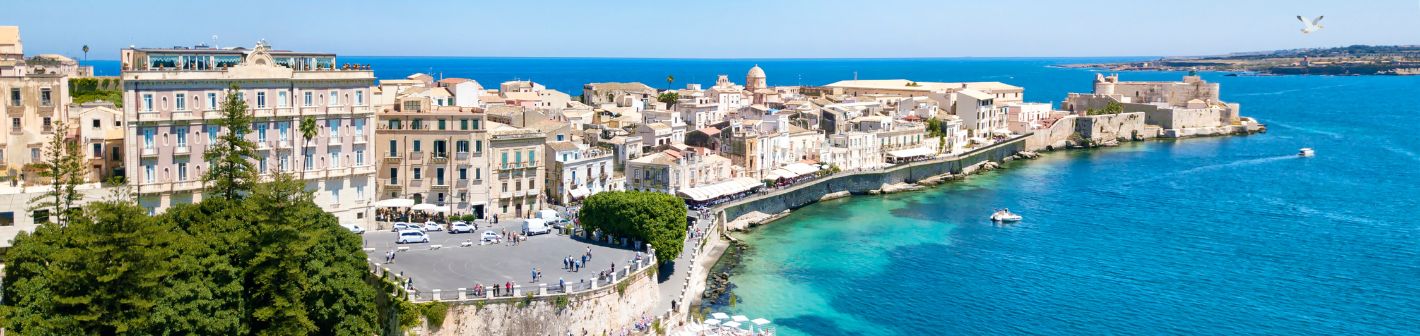
Syracuse in one sentence: World-class antiquity in the Neapolis Archaeological Park and one of Italy’s most beautiful old town islands in Ortigia – a UNESCO World Heritage Site and ideal for culture, city and food travellers. Plan 1–2 days for the city, more with Noto, Vendicari and Marzamemi. You don’t need a car in Ortigia (an extensive ZTL applies); the shade-poor archaeological park is best visited early in the morning in summer.
Syracuse was once one of the most powerful cities of the Greek world – Cicero called it the most beautiful. The huge Greek Theatre and the “Ear of Dionysius” in the Neapolis Archaeological Park still testify to that today. But the city has a second face: Ortigia, the small old town island, where baroque palaces, a cathedral built into an ancient temple, and a lively market crowd together between two harbours.
This duality is what makes the appeal. Antiquity in the park in the morning, then through Ortigia’s alleys to the Fonte Aretusa and the waterfront in the afternoon – the island is compact and largely car-free, ideal for exploring on foot. In the evening the Piazza Duomo and fish restaurants fill up, and locals dive into the sea from the island’s rocks.
The archaeological park is large and offers little shade; in midsummer it’s best visited early in the morning. Ortigia, meanwhile, is packed in the evenings during high season, and arriving by your own car runs into an extensive ZTL. Anyone who plans for that – early into the park, car left on the mainland – gets one of Sicily’s most rewarding cities.
Quick Facts
- Location southeast coast, Province of Syracuse; old town on the island of Ortigia
- Stay 1–2 days for the city; more with Noto, Vendicari, Marzamemi
- Car not needed in Ortigia (ZTL); park on the mainland
- Getting there Catania airport (~1 hr) + train/bus or rental car
- Best time spring & autumn; visit the park early in summer
- Suited for antiquity, baroque, city strolls, food; less for pure beach time
- Highlights Neapolis, Ortigia, cathedral, Fonte Aretusa, Ear of Dionysius
- UNESCO Syracuse & the Rock Necropolis of Pantalica
Is Syracuse worthwhile? (decision guide)
| Traveller type | Well suited | Limitations |
|---|---|---|
| Antiquity & culture | Neapolis (theatre, Ear of Dionysius), Museo Paolo Orsi | the park has little shade – start early in summer |
| City strolls & food | Ortigia: cathedral, market, alleys, waterfront promenade | packed in the evenings during high season |
| Couples | Piazza Duomo, aperitivo by the water, atmosphere | book good restaurants early |
| Without a car | train/bus + walking; Ortigia is compact | Vendicari/Pantalica are hard to reach without a car |
| Families | theatre, market, swimming rocks & coves nearby | plan for heat and longer walks in the park |
Top sights (with time needed & admission)
The city splits into two areas: the Neapolis Archaeological Park on the mainland and the old town island of Ortigia, around 20–30 minutes’ walk or a short bus ride apart.
| Sight | Time / admission | Tip |
|---|---|---|
| Neapolis Archaeological Park (theatre, Ear of Dionysius) | 1.5–2.5 hrs · €14, EU citizens 18–25 reduced €7, under 18 free | go early because of heat/shade; free on the 1st Sunday of the month; daily 8:30am–7:40pm, ticket office until 6:30pm |
| Ortigia: Piazza Duomo & cathedral | 1–2 hrs · square free, small fee for the cathedral | the cathedral is built into an ancient temple of Athena |
| Fonte Aretusa | 20–30 min · free | a freshwater spring with papyrus right on the sea |
| Castello Maniace (tip of the island) | 45–60 min · small admission fee | a Hohenstaufen castle with sea views |
| Museo Archeologico Paolo Orsi | 1.5–2 hrs · €10, reduced €5; combined ticket with Neapolis €18, reduced €9 | one of Sicily’s most important collections of antiquities |
| Ortigia market | 30–60 min · free | mornings; fish, cheese, street food |
Admission prices and opening hours are indicative (as of 3 July 2026) and should be checked before your visit; park hours can vary seasonally. More detail on the park: Neapolis Archaeological Park (German).
The highlights in detail
Neapolis Archaeological Park
The archaeological park brings together the most important ancient remains of Syracuse on one site: the huge Greek Theatre carved into the rock, the Roman amphitheatre, and the stone quarries (Latomie) with the “Ear of Dionysius”, a grotto with unusual acoustics. The visit is worthwhile because it shows the city’s significance in the Greek world more directly than anywhere else. The site is large and offers little shade – come early in the morning in summer and bring water and a hat. More detail: Neapolis Archaeological Park (German).
Ortigia: Piazza Duomo & cathedral
The Piazza Duomo is the central square of the old town island, lined with baroque facades of pale stone. The cathedral itself is remarkable: it was built directly into an ancient temple of Athena, whose Doric columns are still embedded in the outer walls today – Greek antiquity and Christian sacred architecture in a single building. The square is well visited during the day and fills up in the evening; anyone wanting to see the architecture in peace comes early in the morning.
Fonte Aretusa
The Fonte Aretusa is a freshwater spring right on Ortigia’s waterfront promenade, where papyrus grows – one of the few places in Europe with a natural papyrus stand. A Greek myth is attached to the spring, which is part of its appeal as a stop along the way. The visit is brief and combines well with a stroll along the promenade; the pool itself is enclosed and not accessible.
Castello Maniace
At the southern tip of Ortigia stands the Castello Maniace, a 13th-century Hohenstaufen fortress with a distinctive square floor plan. It’s worth visiting for the plain medieval architecture and the wide view over the sea and harbour. The location at the very end of the island means a short walk; check opening hours in advance, as access can be restricted.
Museo Archeologico Paolo Orsi
The Museo Paolo Orsi on the mainland is one of Sicily’s most important collections of antiquities, arranging the finds from Syracuse and its surroundings chronologically – from prehistory through the Greek colonies to Roman times. It complements the archaeological park well, since many original finds from the excavation sites are displayed here. The collection is extensive; anyone short on time can focus on the sections covering the Greek cities.
Ortigia market
The Ortigia market is a lively street market with stalls for fish, vegetables, cheese, spices and street food. It’s worth a visit because it lets you see and sample the southeast’s regional produce in one place, without having to seek out a restaurant first. The market runs in the morning and is largely over by midday – come in the morning to experience the buzz.
Syracuse on video
The following videos from external YouTube channels give a first impression of Syracuse and show both the Neapolis Archaeological Park and the old town island of Ortigia. They’re meant to offer a small glimpse and whet your appetite, but don’t replace your own research before the trip.
Day plans
| Situation | Suggestion |
|---|---|
| Half a day | Neapolis in the early morning (theatre, Ear of Dionysius) |
| One day | Neapolis in the morning, market & lunch break in Ortigia at midday, cathedral/Fonte Aretusa in the afternoon, Piazza Duomo in the evening |
| In the heat | park before 10am, Ortigia’s alleys & museum at midday, a swim off the rocks in the afternoon |
| With children | Ear of Dionysius (acoustics), market, swimming rocks/coves, ice cream at the harbour |
| Two days | day 1 the city, day 2 Noto & Marzamemi or Vendicari |
Getting there
Airport: Catania-Fontanarossa (CTA) is the nearest, around an hour away. Bus: direct buses (including Interbus/AST) connect Catania airport and Catania city with Syracuse. Train: trains run from Catania to Syracuse (around 1–1.5 hrs); the station is on the mainland, from where it’s about 15–20 minutes on foot or a short bus ride to Ortigia. In the city: Ortigia and the centre are explored on foot. Overview: Getting to Sicily.
Parking & ZTL
Ortigia has an extensive ZTL, which at times applies for a large part of the day (most recently up to around 16 hours daily); non-residents may only enter during the release windows. The times were adjusted several times in 2026 – check current details before you travel. The simplest option is to park on the mainland (for example at the Talete garage or at the Molo near the bridge) and walk onto the island. More on ZTLs and parking: Parking in Sicily (German).
Beaches & swimming
Ortigia has no large sandy beaches, but there are swimming rocks and small platforms at the Forte and along the promenade where you can dive into the clear water. Sandy alternatives lie outside the city: Arenella and Fontane Bianche south of the city, and further south the Vendicari nature reserve with unspoiled beaches. More: Beaches in Sicily (German).
Where to stay (areas)
- Ortigia: the best atmosphere, everything on foot, sea and Piazza Duomo on your doorstep – pricier and lively in the evenings during high season.
- Mainland near the station: cheaper and practical for car-free arrival/departure and day trips by train.
- Outside towards the beaches (Arenella/Fontane Bianche): for a beach holiday with a car.
Food & enjoyment
Syracuse is fish country: fresh fish and seafood, plus the classics of the southeast. At the Ortigia market there’s street food and specialities to take away; around the Piazza Duomo, restaurants and wine bars line up. For something sweet, there’s cannoli and granita with brioche. As everywhere: you pay tourist prices on the main squares, while the side alleys often serve better food for less. We only give specific, vetted restaurant recommendations after editorial review – feel free to ask us during a consultation.
Day trips from Syracuse
| Destination | Distance (approx.) | Suitability |
|---|---|---|
| Noto (baroque town, UNESCO) | approx. 40 km | half-day/day trip, also by train/bus |
| Marzamemi (fishing village) | approx. 50 km | half day, most beautiful in the evening |
| Vendicari nature reserve | approx. 35–45 km | day trip, beaches & hiking, a car is useful |
| Pantalica (rock necropolis, UNESCO) | approx. 40 km | half-day/day trip, a car is needed |
| Catania & Etna | approx. 65 km | day trip, by train or car |
Travel times depend on traffic and season – don’t derive them from distance alone.
Common mistakes
- Visiting the archaeological park in the midday heat – it’s large and offers little shade.
- Trying to drive into Ortigia (ZTL) instead of parking on the mainland.
- Reducing Syracuse to a short stop – the park and Ortigia together need a full day.
- Seeing only the antiquities and missing Ortigia’s alleys and market (or the other way round).
Alternatives nearby
- Noto (German) – a baroque town of pale stone, good as a half-day trip.
- Marzamemi (German) – a small fishing village with a tonnara and restaurants on the square.
- Vendicari (German) – a nature reserve with quiet beaches.
- Catania – a lively big city at the foot of Etna.
Frequently Asked Questions
How many days should you plan for Syracuse?
One to two days for Ortigia and the Neapolis Archaeological Park. With Noto, Vendicari and Marzamemi, three to four are worthwhile.
What does admission to the Neapolis Archaeological Park cost?
€14 regular, EU citizens aged 18–25 reduced €7, under 18 free; free on the first Sunday of the month. A combined ticket with the Museo Paolo Orsi costs €18 (reduced €9). Open daily 8:30am–7:40pm, ticket office closes at 6:30pm. Figures as of 3 July 2026 – check before your visit.
Do you need a car in Syracuse?
Not in Ortigia or the centre – the island is compact and has an extensive ZTL. It’s best to park on the mainland and walk. For trips to Vendicari or Pantalica, a car is useful.
How do you get to Syracuse without a car?
Via Catania airport with a direct bus (Interbus/AST) or by train from Catania (around 1–1.5 hrs). From the station it’s a few minutes’ walk or a short bus ride to Ortigia.
What is the Ear of Dionysius?
An ear-shaped grotto in the Neapolis Archaeological Park with unusual acoustics – one of Syracuse’s landmarks.
What is Syracuse famous for?
Syracuse was one of the most powerful cities of the Greek world in antiquity – Cicero called it the most beautiful. The city is famous for the Neapolis Archaeological Park with its Greek Theatre and Ear of Dionysius, as well as the baroque old town island of Ortigia, whose cathedral is built into an ancient temple of Athena.
What can you see in Syracuse?
The main sights are the Neapolis Archaeological Park (Greek Theatre, Roman amphitheatre, Ear of Dionysius), the old town island of Ortigia with the Piazza Duomo, cathedral, Fonte Aretusa and Castello Maniace, the Museo Archeologico Paolo Orsi, and the Ortigia market. The park and Ortigia together comfortably fill a day.
Is Ortigia worth it?
Yes. Ortigia is a compact, largely car-free old town island with baroque squares, the cathedral built into a temple, the Fonte Aretusa, and alleys between two harbours – ideal on foot, most beautiful early in the morning and in the evening.
Plan your Syracuse trip
Combine Syracuse, Noto and the southeast
Our travel agency puts together a suitable route with a hotel in the right location (Ortigia or the mainland), transfers, rental car and excursions – matched to your budget and travel dates. Just send us a no-obligation travel enquiry.
Further reading
- Neapolis Archaeological Park (German) · Province of Syracuse (German) · Noto (German)
- Parking in Sicily (ZTL) (German) · Getting to Sicily · Best time to visit
- Beaches in Sicily (German) · UNESCO World Heritage (German)
As of: 17 June 2026. Opening hours, admission prices and transport offerings are time-dependent and should be checked before your trip. Sources: Parco Archeologico della Neapolis, Comune di Siracusa (ZTL), Trenitalia/Interbus. Weather data: Open-Meteo (CC-BY 4.0).

