
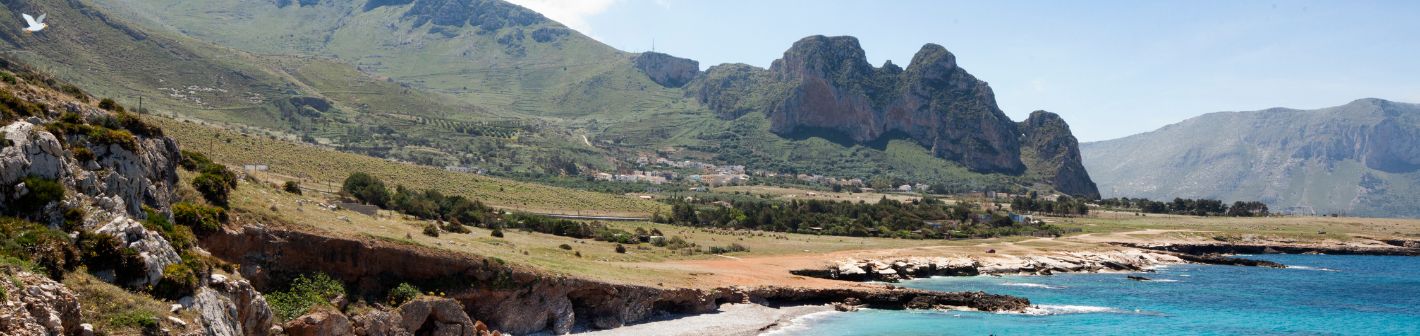
Zingaro Nature Reserve in one sentence: Sicily’s first nature reserve (established 1981) on the northwest coast in the Province of Trapani – a roughly 7 km, car-free coastal trail between Scopello (south entrance) and San Vito Lo Capo (north entrance) with several pebble coves (calette) for swimming. Ideal for hikers and nature lovers seeking clear water without the crowds; less suited to anyone expecting a beach with sunbeds and facilities. Plan for half a day to a full day – sturdy shoes and plenty of water are essential, as there is neither drinking water nor bars anywhere in the reserve.
Quick Facts
- Location: northwest coast, Province of Trapani; between Scopello and San Vito Lo Capo
- Status: Sicily’s first nature reserve (since 1981), car-free
- Size: around 1,600 hectares of protected coastal and mountain landscape
- Coastal trail: approx. 7 km one way; 3–6 hours there and back depending on pace and swim stops
- Entrances: south at Scopello, north at San Vito Lo Capo (no through road)
- Entry fee: roughly €5 for adults as a guideline; check exact prices before visiting
- Swimming: several pebble coves (calette) with clear water; no beach infrastructure
- Bring: plenty of water, sturdy shoes, sun protection, swimwear, food
- Best time: spring & autumn; high summer is hot with little shade
History & Nature
The Riserva Naturale Orientata dello Zingaro was designated in 1981 as Sicily’s first nature reserve. Its creation followed a legendary protest: in the early 1980s, a coastal road was planned between Scopello and San Vito Lo Capo, cutting straight through the untouched area. Thousands of people marched through the bay in protest and stopped the project – the rescued stretch of coastline was subsequently placed under protection. To this day, the citizens’ movement is regarded as the birth of nature conservation on the island. The area is car-free: there is no through traffic, and the only way to get around is on foot.
Across roughly 1,600 hectares, the reserve stretches from rugged limestone cliffs through dense Mediterranean maquis down to the swimming coves. Botanically, the Zingaro is a treasure: its signature plant is the dwarf fan palm (Chamaerops humilis), the only palm native to Europe, alongside several hundred plant species, many typical of dry coastal maquis. Ornithologically, the area is known above all as a breeding site for the rare Bonelli’s eagle (Aquila di Bonelli), which nests in the steep cliffs; numerous other bird species are found here too, along with foxes, porcupines and wild rabbits.
The reserve also has plenty to offer culturally. Several small museums lie along the trails – including a natural history museum, a museum dedicated to traditional manna harvesting, and a collection on the region’s old fishing and farming trades. A highlight is the Grotta dell’Uzzo, a cave with traces of some of Sicily’s earliest inhabitants from prehistoric times. In this way, the Zingaro combines hiking, swimming and nature watching with a glimpse far back into human history.
Trails & Coves
The reserve has several marked routes of varying difficulty. The centerpiece is the lower coastal trail (sentiero costiero), which connects the two entrances over roughly seven kilometres and runs past the coves. Those seeking more elevation and views take the more demanding mid-level or mountain trail. The table below gives a realistic idea of the time needed.
| Trail | Time / Character | Tip |
|---|---|---|
| Coastal trail (sentiero costiero) | approx. 7 km one way · 3–6 hrs there/back | the classic, flattest route along the coves |
| Mid-level trail (sentiero di mezza costa) | longer & higher · more demanding | more elevation gain, wide views over the coast |
| Mountain trail (sentiero alto) | full day · requires fitness | only with good gear, plenty of water and an early start |
| Cala Capreria (from south) | approx. 20 min one way | fastest way to a swim, so often the busiest |
The coves (calette) are the reserve’s other big draw. All are pebble and rock rather than sand, with clear, turquoise water – ideal for snorkelling, but with no facilities whatsoever.
- Cala Capreria – the first and most easily reached cove, about 20 minutes from the south entrance at Scopello. Because it’s so close, it fills up quickly on summer days; anyone wanting more peace and quiet should walk further into the reserve.
- Cala del Varo, Cala Disa & Cala Berretta – the middle coves are reached after longer stretches on the coastal trail. They are quieter and offer the same clear water access over pebbles and rock. Shade is scarce.
- Cala Marinella – closer to the north entrance at San Vito Lo Capo. Those starting from the north reach this cove first. Here too: pebbles rather than sand, no kiosk, no rentals.
Video Impressions from the Riserva dello Zingaro
Entry & Opening Hours
The reserve is open during the day; a moderate entry fee is charged at both entrances, usually payable in cash. Children below a certain age enter free. The following figures are guidelines – prices and, above all, the seasonally changing hours vary and should be checked officially before your visit.
| Category | Guideline | Note |
|---|---|---|
| Adult entry | approx. €5 | paid at the entrances, usually cash |
| Reduced entry | approx. €3 | children/groups – check age limits on site |
| Young children | free | check exact age limit in advance |
| Summer opening | approx. 7:00am–7:30pm | last entry well before closing |
| Winter opening | approx. 8:00am–4:00pm | hours vary seasonally – check officially in advance |
Entry and opening-hours figures are guidelines (as of 12 July 2026) and should be checked before your visit.
Planning Your Visit
The Zingaro is a nature reserve, not a beach resort. There is no shade along the trail, no drinking water and no bars in the area, and no lifeguards. Bring plenty of water per person (more than you think you’ll need), plus sun protection, a hat and sturdy shoes – the trail is stony; water shoes are helpful at the pebble coves. In the midday heat of high summer the hike becomes tiring quickly, so an early start is strongly recommended.
Which entrance is right for you depends on your goal: via the south entrance (Scopello) you reach the first coves the fastest – accordingly, this section is busiest in high season. The north entrance (San Vito Lo Capo) is quieter; from here you reach the northern coves first. The two entrances are not connected by car – you must drive the long way around or hike back the same route. The table below helps you judge whether the Zingaro suits your trip.
| Trip type | Well suited | Limitations |
|---|---|---|
| Hiking & nature | car-free coastal trail, maquis, sea views | little shade, stony paths – sturdy shoes needed |
| Swimming & snorkelling | clear water, quiet pebble coves | no sand, no sunbeds/bars, entry sometimes rocky |
| Families | nearest cove (Cala Capreria) after just approx. 20 min from the south | longer stretches are tiring, heat, no kiosk |
| Seeking peace & quiet | no through traffic, little crowding outside high season | busy in summer and on weekends |
| Comfort beach holiday | – | no facilities; San Vito Lo Capo is the better choice |
Getting There
The most practical way is to arrive by car at one of the two entrances; parking is outside the reserve, and from there you continue on foot only. South: via Scopello; North: via San Vito Lo Capo. There is no through road across the reserve – switching between entrances requires a longer drive around the outside. The regional hub is Trapani. For a regional overview, see Province of Trapani. Without your own car, getting there is cumbersome; in the summer season some buses run from San Vito Lo Capo – check connections in advance.
Best Time to Visit
Ideal are spring (April to June) and autumn (September, October): pleasant temperatures, blooming maquis and bearable sun on the shade-poor trail. In high summer the hike becomes tiring quickly in the midday heat – so be sure to start in the early morning. The visit combines well with the seaside town of San Vito Lo Capo, the port city of Trapani, and a classic beach day – for an overview see Beaches in Sicily. For general guidance, see Best Time to Visit Sicily.
Frequently Asked Questions
How long is the hike through the Zingaro?
The lower coastal trail is about 7 km long (one way). Depending on pace and swimming breaks, plan on roughly 3 to 6 hours there and back. The higher mid-level and mountain trails are longer and more demanding.
Can you swim in the Zingaro?
Yes. Several coves (calette) with clear water lie along the trail, including Cala Capreria, Cala del Varo, Cala Disa and Cala Marinella. These are pebble and rock coves with no sunbeds, bars or umbrellas – bring your own gear.
Where are the entrances?
There are two entrances: the south entrance at Scopello and the north entrance at San Vito Lo Capo. There is no through road across the car-free reserve; to switch between entrances you must drive the long way around or hike back the same route.
What should I bring?
Above all plenty of water, since there is no drinking water or bars in the reserve. Also sun protection and a hat (little shade), sturdy shoes for the stony trail, swimwear and food. In high summer, start early.
What does entry to the Zingaro cost?
A moderate entry fee is charged at the entrances, roughly €5 for adults and about €3 reduced. Exact prices and opening hours change seasonally and should be checked officially before your visit (as of 12 July 2026).
When is the best time to visit the Zingaro?
Spring and autumn are the most pleasant. In high summer it is hot with little shade – start early in the morning and bring enough water.
Our travel agency puts together a route through northwestern Sicily for you – with accommodation in the right location, a rental car and sensible stages around the nature reserve. Just send us a no-obligation travel enquiry.
Plan your Zingaro tripSources & Updates
Basis: editorial local knowledge and generally available information on the Riserva Naturale Orientata dello Zingaro nature reserve (Regione Siciliana, managed by the regional forestry authority). Founded in 1981 as Sicily’s first nature reserve. As of: 12 July 2026. Entry prices, opening hours and access options are time-dependent and should be checked before your trip.

