
Catania in one sentence: Eastern Sicily’s lively big city built from black lava stone – a baroque old town (UNESCO Val di Noto), a famous fish market, a strong street-food scene and the ideal base for Mount Etna. Ideal for city, food and active travellers; less so for flawless postcard idylls. Plan 1–2 days for the city, more if combined with the volcano and coast. No car in the old town (ZTL); the airport lies practically right at the city’s edge.
Catania is the rough, energetic sister of Taormina and Syracuse: a big city built from black lava stone, rebuilt in baroque style after earthquakes and Etna eruptions. The volcano is a constant presence here – as a backdrop at the end of Via Etnea, as a building material in the palazzi, and as a day trip right on the doorstep.
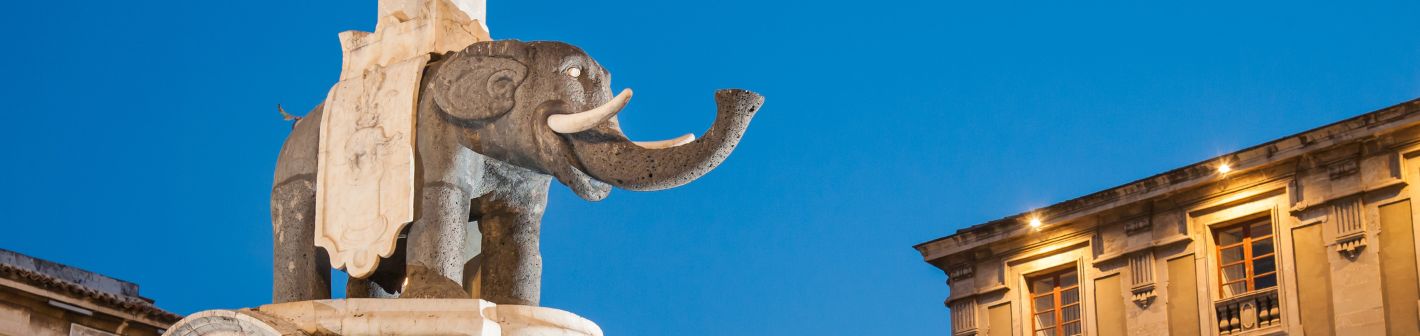
The heart of the city is Piazza del Duomo with the Elephant Fountain, “u Liotru”, Catania’s landmark. Right behind it, the Pescheria bursts into life every morning – one of the liveliest fish markets in Italy. In between lie baroque churches, the sprawling Benedictine monastery, and a Roman theatre tucked among the houses.
Catania is loud, dense and not spotless everywhere – anyone looking for flawless backdrops is better off in Taormina. But if you want an authentic, food-driven big city and the best base for Etna, this is the place. One to two days are enough for the city itself; plan more if you’re including the volcano.
Quick Facts
- Location East coast at the foot of Etna, Province of Catania
- Stay 1–2 days for the city; longer as an Etna base
- Car not needed in the old town (ZTL); useful only for Etna/surroundings
- Getting there Catania Airport (CTA) right at the city; Alibus/train
- Best time spring & autumn; high summer is hot, tiring at midday
- Suited for city life, street food, Etna base; less for pure idyll
- Highlights Piazza del Duomo, Via Etnea, Pescheria, Benedictine Monastery
- UNESCO the cathedral, San Nicolò monastery and other buildings in the centre are part of the serial World Heritage site “Late Baroque Towns of the Val di Noto” (not the whole city)
Who is Catania suited for? (decision guide)
| Traveller type | Well suited | Limitations |
|---|---|---|
| City & baroque | lava-stone architecture, Piazza del Duomo, churches, monastery | loud, lively, hot in summer |
| Street food & market | Pescheria, arancini, pasta alla Norma, granita | market is liveliest in the morning |
| Etna base | short distances to the volcano, buses/tours from the city | check volcano access day-of |
| Without a car | compact centre, airport Alibus, train | Etna/coast harder without a car or tour |
| Beach | city beach La Plaia (sand), Riviera dei Ciclopi (lava) | partly lava/rock; crowded in summer |
Top sights (with time needed & admission)
The baroque centre is compact and walkable. The table below lists the realistic time needed for each sight and, where applicable, the admission price.
| Sight | Time / admission | Tip |
|---|---|---|
| Piazza del Duomo & Elephant Fountain | 30–45 min · free | “u Liotru”, the city’s landmark |
| Cathedral of Sant’Agata | 20–30 min · church free | tomb of composer Vincenzo Bellini |
| La Pescheria (fish market) | 30–45 min · free | mornings; a loud, lively market right behind the cathedral |
| Monastero dei Benedettini (San Nicolò) | 1.5 hrs · guided tour €10, reduced €7.50–3 depending on group (under-7s & disabled visitors free) | guided tours only (Officine Culturali), daily approx. 10am–5pm, book ahead |
| Castello Ursino (Museo Civico) | 1–1.5 hrs · €6, reduced €3 | Hohenstaufen castle, today the city museum; approx. 9:30am–7pm |
| Via Etnea & Villa Bellini | 1–2 hrs · free | grand boulevard with a view of Etna, city park for a break |
Admission prices and opening hours are guide values (as of 3 July 2026) and should be checked before your visit. Around the Festa di Sant’Agata (early February) the city is extremely crowded. We cover Etna itself separately: visiting Etna (German).
The highlights in detail
Piazza del Duomo & Elephant Fountain
Catania’s central square is the baroque heart of the city: framed by the cathedral, the town hall and palazzi built from pale limestone and dark lava stone. At its centre stands the Elephant Fountain, “u Liotru”, an ancient lava figure topped with an Egyptian obelisk, regarded as Catania’s landmark. The square is above all a good starting point: from here, the Pescheria, Via Etnea and the main churches are all within walking distance. To see the square in peace, come early in the morning before traffic and day visitors arrive.
Cathedral of Sant’Agata
The cathedral is dedicated to the city’s patron saint, Agatha, and its baroque facade of lava stone and marble defines Piazza del Duomo. Inside lies the tomb of Vincenzo Bellini, the opera composer born in Catania, which makes the church a worthwhile stop for music lovers too. A visit doesn’t take long and combines well with the square and the fish market. As everywhere in Sicily: dress appropriately, with shoulders and knees covered, or entry may be refused.
La Pescheria (fish market)
Right behind the cathedral lies the fish market, one of the liveliest in Italy: vendors call out their wares, fish and seafood lie on ice, and stalls selling vegetables, cheese and spices fill the gaps between them. The Pescheria is less a sight to look at than an experience straight from the city’s everyday life – and the best place to understand Catania’s street-food scene. It’s most rewarding in the morning; by late afternoon the bustle has largely died down. If you’re sensitive to smells and crowds, plan accordingly.
Monastero dei Benedettini (San Nicolò)
The Benedictine monastery of San Nicolò is one of the largest monastic complexes in Europe and part of the UNESCO World Heritage site Val di Noto. Today the university uses the rooms, but the baroque courtyards, cloisters and the Roman remains uncovered beneath the building can all be visited. Entry is only possible as part of a guided tour, run by Officine Culturali – a plus, since the history of this often-rebuilt complex is hard to grasp without explanation. As tours run at fixed times and are well attended, it’s worth booking ahead.
Accessibility: around 90% of the route is accessible to wheelchair users and people with limited mobility, according to the operator; long, wide corridors are connected by a lift between floors. The entrance from Piazza Dante has a ramp with a small step, and after around 50 metres a further ramp beside the outdoor staircase leads to the inner courtyard. Admission is free for people with disabilities, and companions pay the reduced rate. Before visiting, it’s worth checking the exact requirements with Officine Culturali.
Castello Ursino (Museo Civico)
The massive 13th-century Hohenstaufen castle once stood by the sea; after the 1669 Etna eruption it now sits in the middle of the city, encircled by the solidified lava flow. Inside it houses the city museum (Museo Civico), with archaeological finds, medieval art and paintings. The building itself is also worth seeing from the outside, and is a vivid example of how the volcano has reshaped Catania’s geography. Allow some time for the museum visit if you want to see the collection properly.
Accessibility: access to the ground floor and parts of the exhibition is possible via ramps and a lift; however, some historic rooms, ramparts and outdoor areas have uneven floors and steps, and the towers are not fully accessible. An expansion of accessibility (a new lift) is planned. Before visiting with specific access needs, it’s worth a brief check with the museum.
Via Etnea & Villa Bellini
Via Etnea is Catania’s grand boulevard: running dead straight from the cathedral to the north, lined with shops, cafés and baroque facades – and ending with a view of Etna, which gives the street its name. It’s ideal for a stroll and for watching city life go by. Halfway along lies Villa Bellini, the city’s large park, with palm trees, fountains and shaded paths. Especially in the midday heat, the park is the natural place for a break between sights.
Catania on video
The following videos give a first impression of Catania and show how the city feels between lava-stone baroque, the fish market and the Etna backdrop. They’re meant to offer a small glimpse and whet your appetite for more.
Day plans
| Situation | Suggestion |
|---|---|
| Half a day | Piazza del Duomo → Pescheria → Via Etnea |
| One day | morning: cathedral, Pescheria & market, midday: street food, afternoon: Benedictine monastery or Castello Ursino, evening: Via Etnea |
| In the heat | market and churches early, museum/monastery at midday, Villa Bellini in the shade later |
| With Etna | day 1 the city, day 2 Etna (tour or bus from the city) |
| With children | market, Elephant Fountain, ice cream/granita, city beach La Plaia |
Getting there
Airport: Catania-Fontanarossa (CTA) lies just a few kilometres to the south – eastern Sicily’s main hub. Bus: the Alibus (line 457, AMTS) runs roughly every 20 minutes from the airport to Stazione Centrale and the centre (around €4, ticket valid for 90 minutes on other city buses too). Train: Catania Aeroporto Fontanarossa station lies around 800–900 metres from the terminal and isn’t directly connected on foot; an AMTS shuttle bus links the terminal and the station every 10 minutes. The “Fontanarossa Airlink” combines the train journey and shuttle in a single ticket (shuttle portion around €1); Catania is connected by train to Syracuse, Taormina-Giardini and Messina, among others. For a straight trip into the centre the Alibus is usually more direct; for onward travel towards Syracuse, Taormina or Messina, the train can make sense. In the city: the old town is compact and walkable, plus buses and a small metro. Overview: getting to Sicily.
Parking & ZTL
The centre has a ZTL (restricted traffic zone); for non-residents this means: park outside and continue on foot or by bus/metro. Check the exact zones and times before you arrive, as they can change. You don’t need a car for the city itself – it only becomes useful for Etna, the coast and the surrounding area. More on ZTL and parking: parking in Sicily (German).
Safety
Catania is largely trouble-free for travellers, but it isn’t a particularly quiet city: pickpocketing occurs on buses, in markets and at busy tourist spots such as Piazza del Duomo, the Pescheria and around the train station. Keep valuables close to your body, especially amid the crush of the fish market and on buses to the airport. At night, extra alertness is advisable around Stazione Centrale and in the adjoining side streets (including parts of San Berillo); for the way back late in the evening, a taxi or ride service is the simpler choice. The busy Via Etnea remains well frequented and unproblematic in the evening.
Beaches & coast
Catania has La Plaia, a long sandy beach south of the city (with lidos and free stretches, reachable by bus). Several lidos along La Plaia (including Lido America, Colonia Don Bosco, Lido Le Palme, Lido Polifemo) take part in a Sicilian programme for accessible beach access: reserved parking spaces, non-slip wooden walkways and bathing wheelchairs (“sedie job”); some free stretches along Viale Kennedy also offer such chairs – check exact seasonal availability in advance. To the north begins the Riviera dei Ciclopi, with the lava rocks of Aci Castello and Aci Trezza – more rock bathing than sand, but with clear water and atmosphere. More: beaches in Sicily (German).
Where to stay (areas)
- Old town around Via Etnea / Piazza del Duomo: right in the middle of everything, all on foot, lively in the evening – sometimes noisy.
- Around Piazza Bellini / Via Gemmellaro: the nightlife district with many bars and restaurants – especially lively in the evening, less suited to a quiet night’s sleep.
- Near Stazione Centrale: practical for car-free arrival/departure and day trips by train.
- Ognina (coast to the north): a small harbour, fish restaurants, quieter than downtown, connected by bus.
- Towards Etna / the surrounding area: quieter, with a car, a good base for the volcano.
Food & enjoyment
Catania is the home of pasta alla Norma (with fried aubergine, tomato and salted ricotta). Add to that arancini, fresh fish from the Pescheria, granita with brioche for breakfast, and sweet specialities such as minne di Sant’Agata. The liveliest eating is around the fish market; in the side streets away from Via Etnea it’s often better and cheaper. Vegetarians are well catered for with Norma, caponata and vegetable antipasti. We only give specific, vetted restaurant recommendations after editorial review – feel free to ask us during a consultation.
Day trips from Catania
| Destination | Distance (guide value) | Suitability |
|---|---|---|
| Etna (south or north side) | approx. 1 hr to Rifugio Sapienza | half/full day, bus or tour |
| Aci Castello & Aci Trezza (Riviera dei Ciclopi) | approx. 10–15 km | half day, rock bathing & fish |
| Taormina | approx. 50 km | day trip, good by train/bus |
| Syracuse & Ortigia | approx. 65 km | day trip, train or car |
| Noto (baroque) | approx. 90 km | day trip, best by car |
Travel times depend on traffic and season – don’t rely on distance alone.
Book an Etna tour from Catania
For Etna, guided tours are recommended, as they keep track of access, weather and equipment on a day-to-day basis. Our travel agency puts together a suitable tour from Catania, matched to altitude zone, fitness and time of year.
Common mistakes
- Treating Catania purely as an airport stopover – the city and Etna are worth several days.
- Driving a rental car into the ZTL/old town instead of parking outside.
- Heading to the fish market in the afternoon – it’s liveliest in the morning.
- Planning Etna without checking access and weather on the day.
Alternatives nearby
- Aci Trezza / Aci Castello (German) – a lava coastline with fish restaurants, quieter than the city.
- Taormina – the elegant counterpart to the north, with its ancient theatre.
- Syracuse (German) – antiquity and Ortigia in the southeast.
- Etna villages (e.g. Nicolosi, Zafferana) – as a quieter volcano base.
Frequently Asked Questions
How many days should you plan for Catania?
One to two days for the city itself. As a base for Etna and day trips to Taormina or Syracuse, plan for longer.
How do you get from the airport to the centre?
The easiest way is the Alibus (line 457, AMTS): roughly every 20 minutes to Stazione Centrale and the centre, around €4 (ticket valid for 90 minutes). The airport lies just a few kilometres from the city. Alternatively, the “Fontanarossa Airlink” (train plus shuttle between terminal and station) connects to the rail network – useful mainly for onward travel, less so for the trip into the centre.
Do you need a car in Catania?
Not in the old town – it’s compact and has a ZTL. For Etna and the surrounding area, a car or a guided tour is useful.
Can you visit Etna from Catania?
Yes, Catania is the best base. It takes around an hour to reach Rifugio Sapienza on the south side (by bus or tour). Check access and weather on the volcano on the day – details under “Visiting Etna”.
What should you eat in Catania?
Pasta alla Norma, arancini, fresh fish from the Pescheria and granita with brioche – best enjoyed around the fish market.
Catania or Palermo – which city suits you better?
Both are loud, culture-rich big cities, but with different characters: Palermo has more Arab-Norman UNESCO heritage, larger markets and more sights for multi-day stays. Catania is more compact, closer to Etna, and better suited as a base for volcano and east-coast excursions. If Etna is your priority, Catania is the better fit; if you want more time for city culture, choose Palermo.
Catania or Taormina as a base for the region?
Taormina is more polished and offers more classic postcard scenery, but is more expensive, more touristy and less central for Etna tours without a car. Catania is the more practical, more affordable base, with a direct airport connection and short distances to Etna; Taormina is better suited to a separate day trip or stay.
Plan your Catania trip
Combine Catania with Etna, the coast or Syracuse
Our travel agency puts together a suitable route with a well-located hotel, transfers, rental car and excursions – including Etna tours. Just send us a no-obligation travel enquiry.
Further reading
- Visiting Etna (German) · Province of Catania (German) · Taormina · Syracuse (German)
- Parking in Sicily (ZTL) (German) · Getting to Sicily · Best time to visit
- Beaches in Sicily (German) · UNESCO World Heritage (German)
As of: 3 July 2026. Opening hours, admission prices and transport offerings are time-dependent and should be checked before your trip. Sources: Comune di Catania, Officine Culturali (Monastero dei Benedettini), Museo Civico Castello Ursino, AMTS (Alibus), Trenitalia (Fontanarossa Airlink). Weather data: Open-Meteo (CC-BY 4.0).

