
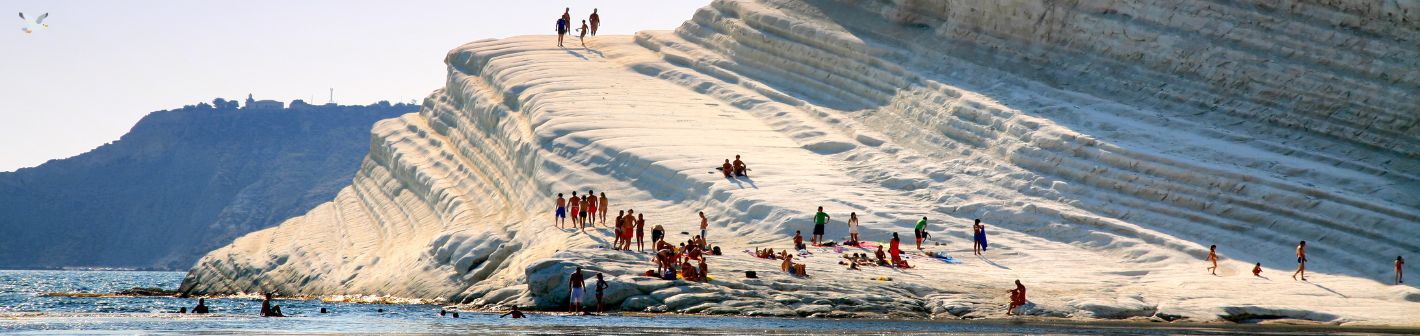
In short: The Scala dei Turchi near Realmonte is a dazzling white marl cliff that rises from the turquoise sea like a staircase – one of Sicily’s most spectacular stretches of coastline, about 15 km west of Agrigento. New in 2026: after years of repeated closures, the beach area at the foot of the cliffs is accessible again, but on a quota basis (limited visitor numbers, ticket around €6, purchased on site). Climbing the white marl remains forbidden – the rock staircase itself has been fenced off since 2020. The finest view, and always free, is from the public belvedere, the neighbouring beaches, and the water. Plan for 1 to 3 hours and combine your visit well with the Valley of the Temples.
Quick-Facts
- Location: south coast, Province of Agrigento; near Realmonte between Realmonte and Porto Empedocle, about 15 km west of Agrigento
- What: white marl cliff in stepped form, on a sandy beach by the sea
- Access in 2026: beach area at the foot is on a quota basis (limited numbers per day), ticket around €6 on site and cashless; climbing onto the rocks is forbidden – rules vary by season, check in advance
- Opening (guideline): roughly 10am–7pm; average visit lasts about 1 hour
- Duration: 1–3 hrs; combines well with Agrigento & the Valley of the Temples in one day
- Car: clearly recommended; public transport is seasonal and limited
- Best time: spring & autumn; high summer is hot, offers little shade and gets crowded
- For: photography and nature lovers, beachgoers at the neighbouring beaches
- Nearby: Valley of the Temples, Agrigento, Sciacca, Lido Rossello
History & name: the “Staircase of the Turks”
The name Scala dei Turchi links shape and history: “Scala” refers to the natural steps of the rock face, while “dei Turchi” – “of the Turks” – recalls the Saracen and Ottoman corsairs who targeted this coast between the 16th and 17th centuries. The sheltered bay, with its gentle slopes, offered an ideal landing point for raids and forays inland; locals referred to the pirates collectively as “Turks”.
Geologically, the formation is made of marl, a white, calcareous sedimentary rock composed of clay and limestone. Over millennia, rain, wind and surf have shaped the soft material into flowing lines and natural steps. In the midday sun the rock glows almost blindingly white, while in evening light it takes on warm cream tones. But this same soft rock is also prone to erosion and rockfall – the reason access to the actual rock staircase has been regulated for years. Geologically, the coastal stretch at Punta di Majata is also considered an important reference site for Pliocene sediment sequences. The Scala is a candidate for the UNESCO World Heritage list and has served as a backdrop for films and series such as “Malèna” and “Commissario Montalbano”.
What you’ll see: the white marl staircase
The centrepiece is the curving, stepped rock face of dazzling white marl that stands out sharply against the turquoise water. The strong contrast makes the formation one of Sicily’s most photographed coastal sights. After the demolition of an illegally built hotel shell – a notorious “ecomostro” – a public belvedere was created above the cliffs, giving you an overview of the formation from above. From here, and from the neighbouring sandy beaches, you get the best view of this natural spectacle, and it’s free at all times. Important: the white rock erodes easily – which is why walking on the staircase itself is not permitted.
Access & current rules (as of 07/2026)
The situation has changed several times: in recent years, direct access to the rock formation was repeatedly closed altogether. Since May 2026, a new, regulated model has been in place with quota-based access to the beach area at the foot of the cliffs. According to media reports, this means around 1,800 visitors per day in groups with staggered entry times, a ticket costing around €6, purchased exclusively on site and cashless (the earlier online reservation has reportedly been discontinued), and an average visit length of about one hour, with opening hours roughly between 10am and 7pm. A free “Pass Bianco” is available for residents, people with disabilities, schools and scientific purposes. Access is partly managed by FAI, with an info point and volunteers.
Still important: climbing onto the white marl is forbidden – a barrier has kept a minimum distance since 2020. A ticket therefore grants access to the beach and viewing area, not permission to climb the rock staircase. Since the system is new, seasonal and has been inconsistent in the past: don’t rely on any one status quo – check the Comune di Realmonte’s current information shortly before your trip, and follow the signage and barriers on site. The visit is worthwhile even without a ticket: the staircase is perfectly visible from the belvedere, the neighbouring beaches, and the sea.
| Access option | What’s possible | Cost / note |
|---|---|---|
| Belvedere / view from above | panoramic view of the formation | free, any time |
| Neighbouring beaches (Lido Rossello, towards Realmonte) | swimming & view of the cliffs | free beach access; bring sun protection |
| Quota-based access to the beach at the foot of the cliffs | up close to the barrier | ticket ~€6, on site/cashless, limited spots |
| From the water (boat, SUP, kayak) | view from the sea | depends on operator, check prices in advance |
| Climbing onto the marl | not permitted | fenced off/closed since 2020 |
Getting there & parking
By car you have the most flexibility. The Scala dei Turchi lies near Realmonte, between Agrigento and Porto Empedocle. From Agrigento, take the SS115 towards Porto Empedocle (about 15–16 km); from Realmonte, it’s just a few kilometres via the coastal road SP68. Near the beach – for example along Via Nereo and the SP68 towards Lido Rossello – there are several car parks, some paid, plus a free municipal car park nearby; in high summer these fill up quickly. You’ll cover the last stretch on foot: the most-used route leads down to the beach in a few minutes via the area of the “Lido Scala dei Turchi” beach venue; you can also reach the formation on foot from Lido Rossello.
Without a car: buses and transfers run from Agrigento or Porto Empedocle – especially in season – but the service is limited and should be checked in advance. A rental car is much more convenient. For an overview of the region, see Province of Agrigento.
Best time to visit & swimming
Ideal times are spring (April to June) and autumn (September, October): pleasant temperatures, good light and smaller crowds. For the finest colours and photos, come early in the morning or in the late afternoon, when the rock glows warmly. In high summer it’s hot, almost shadeless and crowded, and the car parks fill up fast – an early arrival pays off especially then. For a general overview, see Best time to visit Sicily.
At the foot of the cliffs and on the neighbouring beaches you can swim: fine sand, mostly clear, gently shelving water – though after strong wind (Maestrale) the sea can be murkier. Fixed infrastructure such as loungers or bars is limited, so bring water, food and sun protection. More swimming spots at Beaches in Sicily.
Frequently Asked Questions
Can you walk on the Scala dei Turchi?
Climbing onto the white rock staircase is forbidden – for erosion and safety reasons the formation has been fenced off since 2020. Since May 2026 the beach area at the foot of the cliffs is accessible again, though on a quota basis and with a ticket (around €6, purchased on site). Check the current situation with the Comune di Realmonte before your trip.
Does access cost anything?
The view from the public belvedere and the neighbouring beaches is free. For the quota-based access to the beach right below the cliffs, a ticket of around €6 applies in 2026, purchased on site and cashless; a free “Pass Bianco” applies to residents and people with disabilities, among others. The rules are new and seasonal – check in advance.
How do you get there?
The easiest way is by car: the Scala dei Turchi lies near Realmonte, about 15 km west of Agrigento, reachable via the SS115 or the coastal road SP68. Seasonal buses and transfers run from Agrigento/Porto Empedocle, but the service is limited.
Where can you park?
Near the beach there are several car parks (some paid) as well as a free municipal car park; in high summer they fill up early. The last stretch is on foot, usually via the area of the “Lido Scala dei Turchi” beach venue or from Lido Rossello.
Can you swim there?
Yes, at the neighbouring sandy beaches (including towards Realmonte and Lido Rossello) you can swim and enjoy the view of the cliffs. Shade and fixed infrastructure are scarce – bring sun protection, water and food.
Where does the name “Scala dei Turchi” come from?
The name means “Staircase of the Turks” and dates back to the 16th/17th century, when Saracen and Ottoman corsairs – referred to collectively by locals as “Turks” – used the sheltered bay as a landing point.
When is the best time for the Scala dei Turchi?
Spring and autumn are ideal. For good light and fewer crowds, come early in the morning or in the late afternoon; in high summer it’s hot, offers little shade and gets crowded, and car parks fill up quickly.
What else is there to see nearby?
A few kilometres away lie the Valley of the Temples and the city of Agrigento, and to the west the harbour and spa town of Sciacca. Scala dei Turchi, the Valley of the Temples and Agrigento combine well into a single day.
Our travel agency puts together a route along the south coast for you – with the Valley of the Temples, Agrigento, Sciacca and the Scala dei Turchi, plus suitable accommodation and a rental car. Just send us a no-obligation travel inquiry.
Send a travel inquiry nowSources & update
Based on: editorial local knowledge as well as current information from the Comune di Realmonte and media reports (including idealista/news and tp24.it, May 2026) on the new quota-based access, the ticket price and the opening rules. As of: 12 July 2026. Access to the Scala dei Turchi is seasonal, has changed several times in the past, and can change at short notice – please check prices, opening hours and access rules with the Comune di Realmonte and on site before your trip. Climbing onto the rocks is forbidden. Information provided without guarantee.

