
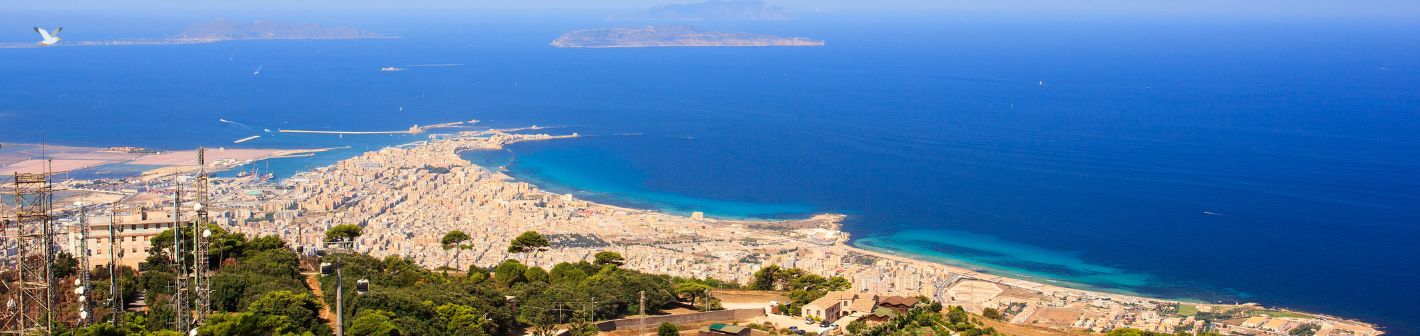
Trapani in one sentence: a relaxed harbour town on a narrow spit of land between two seas – with a compact old town, the salt pans and windmills on its doorstep, the cable car up to Erice and as a gateway to the Egadi Islands. A good, quieter base for the west of Sicily, less so for a high density of sights within the town itself. Plan 1 day for the town, and 3–4 days if using it as a base. Parts of the old town have a ZTL or pedestrian zone at times; Birgi Airport lies around 15 km to the south.
Trapani sits on a narrow, sickle-shaped spit of land at the western tip of Sicily, almost entirely surrounded by the sea. For centuries the town was shaped by salt, tuna fishing and trade with North Africa – still noticeable today, for example in the couscous on local menus. The compact centro storico, with Corso Vittorio Emanuele, baroque churches and the harbour promenade, can comfortably be explored on foot in half a day.
The real appeal lies in the surrounding area: south of the town stretch the Saline di Trapani e Paceco, a nature reserve with salt pans and old windmills, especially atmospheric at sunset. From the edge of town the cable car (Funivia) takes around ten minutes up to Erice, and fast boats leave the harbour for the Egadi Islands of Favignana, Levanzo and Marettimo.
Anyone expecting a dense big-city backdrop like Palermo or Catania will find Trapani modest in scale – the town itself has few major individual highlights. But if you’re looking for a quieter base from which to explore the whole west (Erice, Segesta, Marsala, San Vito Lo Capo, the islands), this is the right place. A rental car is useful here, since the destinations are spread out.
Quick-Facts- Location Western tip of Sicily, narrow spit of land, Province of Trapani
- Time needed 1 day for the town; 3–4 days as a base for the west
- Car not needed in the old town (ZTL/pedestrian zone); useful for the surrounding area
- Getting there Trapani-Birgi Airport (TPS) ~15 km south; alternatively Palermo
- Best time spring and autumn; for the beach and islands, June and September
- Good for a quiet base, food and wine, islands & salt pans; less so for pure city density
- Highlights salt pans & Museo del Sale, old town, cable car to Erice, harbour
- Islands Egadi Islands (Favignana/Levanzo/Marettimo) from Trapani harbour
| Travel type | Good for | Limitations |
|---|---|---|
| Base for the west | central for Erice, Segesta, Marsala, San Vito, the islands | destinations are spread out – a car is useful |
| Culture & old town | compact lanes, baroque architecture, harbour promenade | few major individual highlights |
| Food & wine | couscous alla trapanese, fish, salt, Marsala nearby | — |
| Islands | fast boats to Favignana/Levanzo/Marettimo | weather-dependent, busy in summer |
| Without a car | compact centre, harbour & cable car easy to reach | surrounding area (Segesta/Marsala) harder without a car |
The centre is compact and easy to explore on foot; the main attractions lie around the town. The table below gives a realistic time estimate for each destination and, where applicable, the admission price.
| Destination | Time / admission | Tip |
|---|---|---|
| Old town / Centro storico | 2–3 hrs · free | Corso Vittorio Emanuele, churches, Via Garibaldi |
| Saline di Trapani e Paceco (nature reserve) | 1–2 hrs · free access | salt pans & windmills; light is best at sunset |
| Museo del Sale (Nubia/Paceco) | 30–45 min · approx. €5, reduced ~€3 | housed in an old windmill; seasonal opening, check in advance |
| Funivia (cable car) to Erice | 10 min ride · €9 one way, €15 return | replacement taxi in strong winds; maintenance on Monday mornings |
| Torre di Ligny & the town’s tip | 45–60 min · tower/museum admission minimal | watchtower on the headland between the two seas |
| Day trip to Segesta (temple/theatre) | half a day · €14, reduced €7; shuttle to the theatre €16.50, reduced €9.50 | Doric temple & ancient theatre; best with a car |
Admission prices, cable car and ferry times, and opening hours are indicative (as of 17 June 2026) and should be checked before your visit. The Funivia usually runs about 6:30am–11:30pm and on Mondays only from early afternoon due to maintenance; in strong winds a replacement taxi service operates. The Museo del Sale has seasonally limited hours.
The highlights in detail
Old town / Centro storico
The centro storico runs as a narrow sequence of lanes and squares along the spit of land, with Corso Vittorio Emanuele as its baroque main axis, several churches and Via Garibaldi. It’s worthwhile because town history, harbour life and café culture combine here over short distances, without long trips out. Honestly, it’s less about individual must-see sights than the atmosphere of strolling around – treat the centre as a relaxed town walk in the morning or early evening, not a checklist.
Saline di Trapani e Paceco
South of the town lies the Saline di Trapani e Paceco nature reserve: a mosaic of shallow salt pans, small salt mounds and historic windmills that are still used for salt production today. It’s worth visiting for the unusual, wide-open landscape and birdlife – the site itself is freely accessible. Honest tip: come in the late afternoon or at sunset, when the light is best; at midday it’s flat and hot, with little shade. Anyone wanting to see more about salt and the neighbouring salt pans can combine this well with a side trip to Marsala.
Museo del Sale (Nubia/Paceco)
The Museo del Sale is housed in an old windmill on the edge of the salt pans and uses tools and explanations to show how sea salt was traditionally extracted here. It’s a compact, illustrative addition to a walk through the salt pans, especially if you want to understand what you’re seeing outside. Practical tip: the visit only takes about half an hour, but opening hours are seasonally limited – check in advance and ideally combine it directly with sunset at the salt pans.
Funivia (cable car) to Erice
The Funivia is the cable car that runs from the edge of town up to the medieval hill town of Erice in around ten minutes. It’s worthwhile because you avoid the traffic on the winding mountain road, and the ride gives you a view over the town, the salt pans and the coast. Important in practice: in strong winds the cable car stops running and a replacement taxi service takes over, and on Monday mornings there’s maintenance, so it only starts running in the early afternoon. If you want to stay flexible, check the wind and operating hours beforehand.
Torre di Ligny & the town’s tip
The Torre di Ligny is an old watchtower at the very tip of Trapani’s headland, where the Tyrrhenian and Mediterranean seas meet; the tower houses a small museum. The walk there along the harbour promenade is worthwhile mainly for the location between the two seas and the open view of the water. Realistically, just under an hour is enough including the walk; it’s lovely in the late afternoon, when the light softens and the promenade gets livelier.
Trapani on video
The following videos from external YouTube channels give a first impression of Trapani, the salt pans and the old town.
Day plans
| Situation | Suggestion |
|---|---|
| Half a day | old town → harbour promenade → Torre di Ligny |
| One day | old town in the morning, couscous/fish at midday, salt pans & Museo del Sale in the afternoon, sunset at the salt pans |
| With Erice | cable car up to Erice in the morning, back in the afternoon, evening in Trapani |
| With the islands | early boat to Favignana, a day on the island, back in the evening |
| With children | salt pans with windmills, ice cream/granita, a short boat trip |
Getting there
Airport: Trapani-Birgi “Vincenzo Florio” (TPS) is about 15 km south of the town and is served mainly by low-cost airlines; alternatively, you can arrive via Palermo (PMO). Bus: Buses from the airport (including AST and Autoservizi Salemi) run to the centre or the harbour; the AST line to the harbour currently costs €4.90 and takes around 20 minutes, while other providers/destinations within the town may take longer and have different fares. Timetables change seasonally – check in advance. Train/bus, regional: Trapani is connected by bus and train to Palermo and Marsala, among others; for the west, a rental car is usually the most flexible solution. Ferries/islands: hydrofoils (Liberty Lines) run from the harbour to the Egadi Islands. Overview: Getting to Sicily.
Parking & ZTL
The centro storico has a ZTL and pedestrian zones that apply depending on the season and time of day (including around Corso Vittorio Emanuele and Via Torrearsa). For non-residents that means parking outside and continuing on foot. Large car parks can be found at Piazza Vittorio Emanuele and Piazzale Ilio, among others; anyone heading to the islands by boat can use the guarded car parks at the harbour. Zones, times and rates can change and should be checked before you travel. More on ZTL and parking: Parking in Sicily.
Beaches & coast
Trapani itself isn’t a classic beach town – town beaches like Spiaggia San Giuliano lie a bit outside the centre. The best-known sandy beaches of the west lie to the north: San Vito Lo Capo, with its wide, pale sandy beach and the nearby Zingaro nature reserve, is easily reached from Trapani as a day trip. The Egadi Islands also score with their coves. More: San Vito Lo Capo and Sicily’s beaches.
Where to stay (locations)
- Old town / Centro storico: right in the middle, everything on foot, close to the harbour for island trips – mind the ZTL in places.
- Near the harbour: practical for early boats to the Egadi Islands and car-free days.
- Surrounding area / towards the salt pans or Erice: quieter, with a car, good as a base for the west.
Food & wine
Trapani is known for couscous alla trapanese – a fish couscous that shows the North African influences on the west coast. There’s also pesto alla trapanese (with tomatoes, almonds, garlic and basil, usually with busiate pasta) and fresh fish, tuna in particular. Local sea salt from the salt pans and Marsala wine from the neighbouring town round out the picture. Vegetarians are well catered for with pesto trapanese, caponata and vegetable antipasti. We only give specific, vetted restaurant recommendations after editorial review – feel free to ask us during a consultation.
Day trips from Trapani
| Destination | Distance / journey (approx.) | Suitability |
|---|---|---|
| Erice | Funivia ~10 min, by car ~30 min | half day, medieval hill town |
| Salt pans / Marsala | approx. 30 km to Marsala | half/full day, salt & Marsala wine |
| Segesta | approx. 35 km | half day, Doric temple & theatre |
| San Vito Lo Capo / Zingaro | approx. 40 km | day trip, beach & nature reserve |
| Egadi Islands (Favignana) | boat approx. 30 min from the harbour | day trip, coves & cycling |
Travel and boat times depend on traffic, season and weather – don’t estimate them from distance alone. Island connections can be cancelled in strong winds.
Common mistakes
- Seeing Trapani only as a transit point for the airport or harbour – the salt pans and surrounding area are worth more of your time.
- Driving a rental car into the old town’s ZTL/pedestrian zone instead of parking outside.
- Visiting the salt pans at midday – the best light is in the late afternoon and at sunset.
- Planning island trips without checking the weather – hydrofoils are cancelled in strong winds.
- Heading to the Funivia on Monday mornings – that’s when maintenance takes place, with operations starting only in the afternoon.
Alternatives nearby
- Erice – medieval hill town above the city, reachable by cable car.
- Marsala – wine, salt pans and history in the south of the province.
- San Vito Lo Capo – sandy beach and the Zingaro nature reserve to the north.
- Favignana – the largest of the Egadi Islands, easily reached by boat from Trapani.
How many days should you plan for Trapani?
One day is enough for the town and the salt pans. As a base for Erice, Segesta, Marsala, San Vito Lo Capo and the Egadi Islands, three to four days make sense.
How do you get from Trapani to Erice?
Most comfortably by cable car (Funivia): around a ten-minute ride, currently €9 one way or €15 return. In strong winds a taxi service replaces the cable car, and on Monday mornings it’s closed for maintenance. Alternatively, by car via the winding mountain road.
Can you reach the Egadi Islands from Trapani?
Yes, by hydrofoil (Liberty Lines) from the harbour. Favignana can be reached in around half an hour, while Levanzo and Marettimo take a bit longer. Services can be cancelled in strong winds.
How do you get from Trapani-Birgi Airport into the centre?
By bus to the harbour: the AST line currently costs €4.90 and takes around 20 minutes. Other providers and destinations within the town may take longer and have different fares. The airport is about 15 km to the south – check seasonal timetables in advance.
When is the best time to visit Trapani?
Spring and autumn are pleasant. June and September are especially good for the beach and the islands; high summer is hot and busier.
Plan your Trapani trip
Combine Trapani with western Sicily
Our travel agency puts together a suitable route with a hotel in the right location, transfers, car rental and excursions – salt pans, Erice, Segesta, Marsala and island trips included. Just send us a no-obligation travel request.
- Erice · Marsala · San Vito Lo Capo · Favignana · Province of Trapani
- Island hopping in Sicily · Parking in Sicily (ZTL) · Getting to Sicily
- Sicily by rental car · Best time to visit · Sicily’s beaches
As of: 17 June 2026. Opening hours, admission prices, and cable car and ferry times are time-dependent and should be checked before your trip. Sources: Funivia di Erice, Liberty Lines, Museo del Sale (Nubia/Paceco) and Riserva Saline di Trapani e Paceco, Trapani-Birgi Airport (TPS), AST/Autoservizi Salemi, Comune di Trapani (ZTL). Weather data: Open-Meteo (CC-BY 4.0).

