
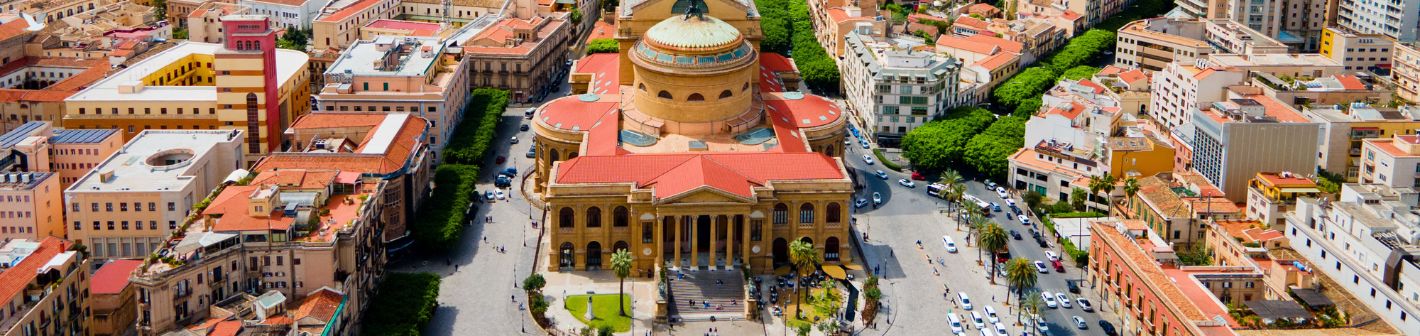
In short: The Teatro Massimo Vittorio Emanuele on Piazza Verdi is Italy’s largest opera house and one of Europe’s largest – a monumental neo-Renaissance building, opened in 1897 and world-famous as the setting for the final scene of “The Godfather Part III”. The best part is the magnificent interior, which you can only see on a guided tour (around 40 minutes) or with a performance ticket. Worthwhile for architecture, culture and opera lovers; for a quick photo stop, the grand staircase from outside is enough. Best to book tours and tickets in advance, especially in high season.
Quick Facts
- What Italy’s largest opera house; opera, ballet, concerts and daytime tours
- Location Piazza Verdi, central Palermo (Province of Palermo)
- Style Historicism / neo-Renaissance, designed by Giovanni Battista Filippo Basile
- Opened 16 May 1897 with Verdi’s “Falstaff”
- Size around 1,300 seats across several tiers of boxes; monumental dome
- Tour around 40 minutes, multilingual; adults €12, under-26s €6
- Time needed tour approx. 40 min; a performance is a whole evening
- Getting there on foot from the old town; bus stops nearby
- Known from the final scene of “The Godfather Part III” (1990)
History: From the Foundation Stone to the Reopening
The Teatro Massimo was built during an economic and cultural golden age in Palermo, which at the end of the 19th century sought to present itself as a European cultural capital. The competition for the new building was won by the Sicilian architect Giovanni Battista Filippo Basile; the foundation stone was laid in 1875. When Basile died, his son Ernesto Basile completed the immense project – a master of Sicilian Art Nouveau, who gave the building many of its decorative details. After roughly two decades of construction, the opera house was ceremonially opened on 16 May 1897 with Giuseppe Verdi’s “Falstaff”.
Named after King Vittorio Emanuele II, the “Massimo” (Italian for “the largest”) quickly became a landmark of the city and Italy’s largest opera house. The 20th century, however, brought a deep rupture: in 1974 the house closed for urgently needed renovation work – and remained closed for around 23 years due to structural, financial and political reasons. Only after an extensive restoration was the Teatro Massimo reopened in 1997, right on time for its 100th anniversary. Since then it has been in continuous use again and ranks among the country’s most renowned stages.
The building gained worldwide fame in 1990 through film: the dramatic final scene of “The Godfather Part III” plays out on the grand staircase and inside the Teatro Massimo – to this day a reason many travellers come here specifically.
What You’ll See
Even from outside, the monumental building impresses: a broad grand staircase, flanked by two bronze lion figures, leads up to a portico supported by tall Corinthian columns; above it rises the characteristic dome that dominates Piazza Verdi. This staircase is also the famous setting from “The Godfather Part III”.
The real highlight, however, lies inside, which you can only enter on a guided tour or with a performance ticket:
- Auditorium – a classic horseshoe-shaped hall with several tiers of boxes and around 1,300 seats, richly decorated with gold, velvet and stucco.
- Royal Box (Palco Reale) – the largest and most opulent box, positioned centrally opposite the stage, once reserved for the royal family.
- Acoustic dome – the ceiling above the auditorium is an elaborately painted, movable construction of metal panels that could be opened. It contributes decisively to the hall’s famous acoustics, regarded as among the best in Europe.
- Foyer & state rooms – the spacious entrance foyer and the richly decorated salons (such as the Sala Pompeiana and the Sala degli Stemmi) showcase the splendour of the Belle Époque.
Tours & Opening Hours
During the day you can experience the Teatro Massimo on a guided tour. The tour lasts around 40 minutes and takes you through the auditorium, foyer, tiers and selected state rooms; it is offered multilingually (including Italian and English, among others). Tours generally run daily from 9:30am, roughly every half hour until early evening. On days with rehearsals or performances, the daytime programme is sometimes limited.
| Tour | Price | Note |
|---|---|---|
| Adults (intero) | €12 | around 40 min, multilingual |
| Reduced (under 26) | €6 | with ID |
| Groups (20+ people) | €9 pp | reservation only |
| Palermo residents | €4 | with proof of residency |
| Façade & grand staircase | free | accessible from outside at any time |
Prices and times are guidelines (as of 12 July 2026) and may change; on performance days the daytime tour is sometimes limited. Please check the official Fondazione Teatro Massimo website in advance and book early, especially in high season.
Planning Your Visit
There are two ways to experience the building from the inside. The simplest is the daytime tour: book your ticket online in advance where possible via the opera house’s official website, and you’re guaranteed a spot even on busy days. A lovely alternative is attending a performance – an opera, a ballet or a concert. Then you experience the hall in action, with orchestra and audience; tickets vary in price depending on seat and production and sell out quickly in high season. Those with little time can photograph the staircase and façade from outside – but then miss the truly worthwhile interior.
A common mistake is spontaneously planning a daytime tour on a performance day: on such days the tour schedule is often reduced. So check the programme and current tour times in advance.
Getting There
On foot: the Teatro Massimo sits centrally on Piazza Verdi and is easily reached on foot from the old town – for instance via Via Maqueda from the Quattro Canti in just a few minutes. Bus: several city bus lines stop nearby. Car: central Palermo has narrow streets and, in places, access restrictions (ZTL); your own car is not necessary for the visit and rather a hindrance – better to park outside the centre. More on the city and region: Palermo and Province of Palermo.
Best Time to Visit
Because the visit takes place indoors and air-conditioned, the Teatro Massimo is a good destination year-round – also as a cool, shaded option on hot summer days in Palermo. Pleasant for the city itself are spring (April to June) and autumn (September, October). The opera and ballet season runs mainly from autumn to spring; in summer there’s a separate programme with concerts and open-air formats. For general guidance, see Best Time to Visit Sicily.
Frequently Asked Questions
Can you visit the Teatro Massimo without a performance?
Yes. During the day, guided tours of around 40 minutes are offered, showing you the auditorium, foyer and state rooms. It’s best to book tickets in advance; on performance days the schedule can be limited.
How much does a tour cost?
The standard tour costs €12 for adults and €6 reduced for those under 26. Groups of 20 or more pay €9 per person, Palermo residents €4. Prices as of 12 July 2026, please check in advance.
How much time should you plan?
Around 40 minutes for a tour, a whole evening for a performance visit. Those wanting only to photograph the staircase and façade need just a few minutes – but then miss the best part, the interior.
Why is the Teatro Massimo so famous?
It is Italy’s largest opera house, a monumental late-19th-century building with internationally acclaimed acoustics. It also became world-famous as the setting for the final scene of “The Godfather Part III”.
Do you need to book tickets in advance?
Recommended, yes – both for tours and for performances. Slots are in demand, especially in high season. Prices and times are guidelines (as of 12 July 2026) and should be checked in advance on the opera house’s official website.
Are the tours multilingual?
Yes, tours are offered in several languages, generally including Italian and English among others. Exact language availability varies by time slot – best to check in advance or select when booking.
Was “The Godfather Part III” really filmed here?
Yes, the film’s dramatic final scene (1990) takes place at and inside the Teatro Massimo, including the well-known sequence on the grand staircase. There is, however, no dedicated film museum.
Combine the Teatro Massimo with Palermo and western Sicily
Our travel agency puts together a route through Palermo and the west of the island for you – with a hotel in the right location, rental car, transfers and sensible stages, including a tour or opera evening at the Teatro Massimo on request. Just send us a no-obligation travel enquiry.
Further Reading
Sources & Updates
Basis: official information from the Fondazione Teatro Massimo (Palermo) on tours, prices and times, along with editorial general knowledge of the building’s and city’s history. As of: 12 July 2026. Opening hours, tour and ticket prices, and programme schedules are time-dependent and should be checked on the opera house’s official website before your trip.

