
The Pelagie Islands in one sentence: Sicily’s southernmost outpost – a small archipelago (Lampedusa, Linosa, the uninhabited Lampione) out in the open Mediterranean, geographically closer to Africa than to Sicily, administered by the Province of Agrigento. Worthwhile for beach, snorkelling and nature travellers looking for clear water and seclusion; less so for anyone on a tight schedule or wanting spontaneous flexibility. The journey is long (flight or a multi-hour ferry from Porto Empedocle), and services are highly seasonal. Plan for at least several days – a day trip isn’t worthwhile. As of: 19 June 2026.
The Pelagie Islands (Italian: Isole Pelagie, from Greek pélagos = open sea) lie at the very southern edge of Italian territory, far out in the Mediterranean between Sicily and Tunisia. Administratively they belong to the Province of Agrigento, but geographically the matter is clear: Lampedusa and Lampione already sit on the African continental shelf, making them closer to Tunisia than to the Sicilian coast.
The archipelago consists of three islands: Lampedusa, the largest and the only one with any notable infrastructure; Linosa, a smaller volcanic island with dark lava beaches and only a few hundred inhabitants; and Lampione, a tiny, uninhabited rock important mainly for divers and as a seabird refuge. Together, Lampedusa and Linosa form the municipality of Lampedusa e Linosa.
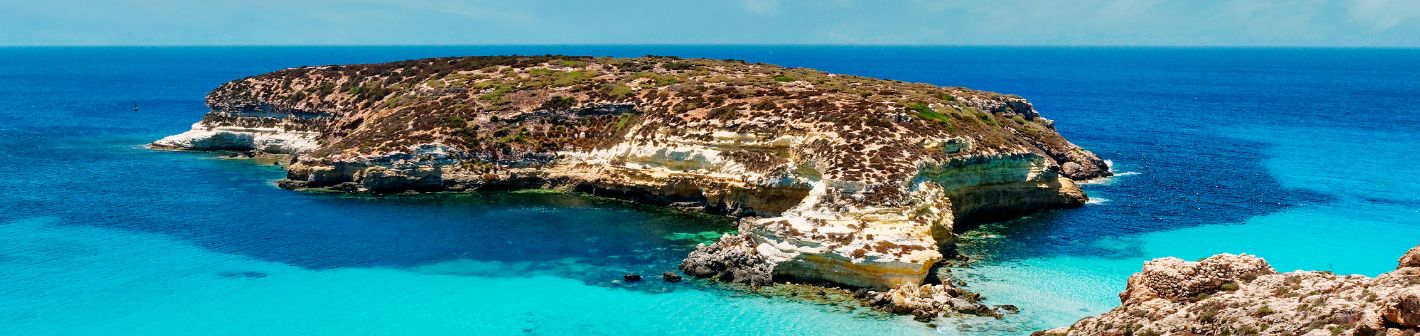
The appeal lies in the clear water, the rugged landscape and the nature: Lampedusa is known for the Spiaggia dei Conigli (Rabbit Island Beach), one of Italy’s most photographed beaches, as well as for the surrounding marine protected area where loggerhead sea turtles (Caretta caretta) nest. Anyone coming here should expect a long journey, highly seasonal infrastructure and weather-dependent ferries – but in return will experience a seclusion that’s now hard to find anywhere else in the Mediterranean.
Quick Facts
- Location the southernmost tip of Italy, open Mediterranean between Sicily and Tunisia; closer to Africa than to Sicily
- Administration Province of Agrigento; municipality of Lampedusa e Linosa
- Islands Lampedusa (largest, inhabited), Linosa (volcanic island, inhabited), Lampione (uninhabited rock)
- Stay several days; a day trip isn’t worthwhile given the journey
- Getting there flight (seasonal, including from Sicily) or a multi-hour ferry from Porto Empedocle
- Best time late spring to early autumn; services are heavily reduced outside the season
- Good for beach, snorkelling, diving and nature travellers; less so on a tight schedule
- Nature conservation marine protected area; Spiaggia dei Conigli has regulated access, nesting site of the loggerhead sea turtle
Who Are the Pelagie Islands Good For? (Decision Helper)
| Travel type | Good for | Limitations |
|---|---|---|
| Beach & swimming | clear water, Spiaggia dei Conigli, secluded coves | access to protected zones is regulated; crowded in high season |
| Snorkelling & diving | clear visibility, Lampione as a diving spot, intact underwater world | boat-dependent; depends on weather and sea conditions |
| Nature & quiet | marine protected area, sea turtles, rugged landscape | remote, long journey, little to do in bad weather |
| Volcano & hiking (Linosa) | lava beaches, crater, unspoiled character | very small island, minimal infrastructure |
| Flexible short-trip travellers | – | long journey, ferries not guaranteed; not worthwhile as a day trip |
The Islands in Detail
Lampedusa
Lampedusa is the largest island of the archipelago and the only one with any notable tourist infrastructure: a harbour, a town with accommodation and restaurants, and an airfield. The landscape is barren and flat, characterised by pale limestone – quite different from volcanic Linosa. The best-known spot is the Spiaggia dei Conigli, with its offshore Rabbit Island and water often described as especially clear. The beach lies within a protected area; access is regulated to protect the nesting site of the loggerhead sea turtle. Exact rules, access times and any quotas can vary by season and should be checked locally.
Linosa
Linosa is a small volcanic island with dark lava rock, black to reddish beaches and only a few hundred inhabitants. It feels noticeably more unspoiled and quieter than Lampedusa, but offers correspondingly little infrastructure. People who come here are usually looking for exactly that: seclusion, simple accommodation and a character that feels more like a volcanic Mediterranean island than a beach resort. It’s connected by the same ferry services as Lampedusa.
Lampione
Lampione is a tiny, uninhabited rock west of Lampedusa. It has no infrastructure and isn’t regularly inhabited or visited. Its importance lies mainly as a diving and snorkelling destination with clear visibility and rich marine life, as well as a refuge for seabirds. A visit is only possible by boat and within the framework of nature conservation regulations.
Getting There
Getting there is the key planning factor – the Pelagie Islands lie far out at sea and can’t be reached on a whim.
Flight: Lampedusa has an airport served seasonally (including from Sicilian airports and, in part, from mainland Italy). Services are seasonal and considerably reduced outside peak season. Ferry: Ferries run from the port of Porto Empedocle (near Agrigento) to Lampedusa and Linosa; the crossing is long and, depending on the route, can take several hours. Ferries depend on weather and sea conditions and aren’t guaranteed – cancellations can occur in bad weather. Specific timetables, journey times and prices change seasonally and should be checked with the relevant operator before booking.
If you’re travelling without a flight, it makes sense to combine the islands with a stay around Agrigento or in the Province of Agrigento, from where the Porto Empedocle ferry port is accessible.
Beaches & Nature Conservation
The heart of the Pelagie Islands is nature – and that’s exactly what’s protected. A marine protected area extends around Lampedusa and Linosa, covering parts of the coastline and the underwater world. For travellers, that means clear water and intact habitats, but also rules that should be respected.
The Spiaggia dei Conigli is the best-known beach and at the same time a sensitive nesting site of the loggerhead sea turtle (Caretta caretta). Access is regulated – depending on the season, access times, paths and behaviour rules may apply, for instance to avoid disturbing egg-laying and hatchlings. These rules exist for protection and should be taken seriously; exact requirements should be checked locally or with the protected area management. Besides Lampedusa, Lampione also offers a glimpse of the underwater world as a diving spot, likewise within the protection regulations.
If you’re looking for beaches on the main island, you’ll find an overview at Beaches in Sicily.
Common Mistakes
- Planning the Pelagie Islands as a day trip – the long journey is only worthwhile for several days.
- Assuming ferry connections are guaranteed – they depend on the weather and can be cancelled; always build in a buffer.
- Travelling outside the season and expecting a full range of accommodation, restaurants and connections.
- Ignoring the access rules at the Spiaggia dei Conigli and in the marine protected area.
- Confusing Lampedusa with volcanic Linosa – they’re very different landscapes.
Alternatives
- Province of Agrigento – a mainland base near the ferry port, with the Valley of the Temples and coastline.
- Agrigento – starting point for the crossing and a cultural stop before or after the islands.
- Island Hopping Sicily – for anyone wanting to combine several offshore islands.
- Beaches in Sicily – clear coves without a long ferry crossing too.
Frequently Asked Questions (FAQ)
Where are the Pelagie Islands?
At the very southern edge of Italy, far out in the Mediterranean between Sicily and Tunisia. They belong to the Province of Agrigento but are geographically closer to Africa than to Sicily.
Which islands belong to the archipelago?
Lampedusa (the largest and the only one with notable infrastructure), Linosa (a smaller volcanic island) and Lampione (a tiny, uninhabited rock, important mainly for divers and seabirds).
How do you get to the Pelagie Islands?
By flight to Lampedusa (seasonal) or by ferry from Porto Empedocle near Agrigento. The ferry crossing takes several hours and depends on the weather; timetables and prices change seasonally and should be checked in advance.
What is the Spiaggia dei Conigli?
Lampedusa’s best-known beach, with an offshore Rabbit Island and clear water. It lies within a protected area and is a nesting site of the loggerhead sea turtle; access is regulated to protect the animals.
Is a day trip worthwhile?
No. Because of the long journey and weather-dependent ferries, a visit is only worthwhile from several days onward. Outside the main season, services are also heavily reduced.
Pelagie Islands – Plan Your Trip
Combine Lampedusa & Linosa with Sicily
Our travel agency puts together a route for you – with a stay around Agrigento, the right connection to the islands, and realistic planning for the journey and season. Just send us a no-obligation travel request.
Read More
- Province of Agrigento · Agrigento
- Island Hopping Sicily · Beaches in Sicily
- Best Time to Visit Sicily
As of: 19 June 2026. Ferry timetables, flight schedules, opening hours and access rules for protected areas are time-dependent, seasonal and should be checked before your trip. Ferries are weather-dependent and not guaranteed.
{“@context”:”https://schema.org”,”@graph”:[ {“@type”:”BreadcrumbList”,”itemListElement”:[ {“@type”:”ListItem”,”position”:1,”name”:”Home”,”item”:”https://www.treffpunkt-sizilien.de/en/”}, {“@type”:”ListItem”,”position”:2,”name”:”Province of Agrigento”,”item”:”https://www.treffpunkt-sizilien.de/en/province-of-agrigento/”}, {“@type”:”ListItem”,”position”:3,”name”:”Pelagie Islands”,”item”:”https://www.treffpunkt-sizilien.de/en/pelagie-islands/”}]}, {“@type”:[“Place”,”TouristDestination”],”name”:”Pelagie Islands (Isole Pelagie)”,”description”:”Sicily’s southernmost archipelago in the open Mediterranean between Sicily and Tunisia: Lampedusa, Linosa and the uninhabited Lampione. Administered by the Province of Agrigento, known for clear water, the Spiaggia dei Conigli, a marine protected area and nesting loggerhead sea turtles.”,”containedInPlace”:{“@type”:”AdministrativeArea”,”name”:”Province of Agrigento, Sicily”}}, {“@type”:”FAQPage”,”mainEntity”:[ {“@type”:”Question”,”name”:”Where are the Pelagie Islands?”,”acceptedAnswer”:{“@type”:”Answer”,”text”:”At the very southern edge of Italy, far out in the Mediterranean between Sicily and Tunisia. They belong to the Province of Agrigento but are geographically closer to Africa than to Sicily.”}}, {“@type”:”Question”,”name”:”Which islands belong to the archipelago?”,”acceptedAnswer”:{“@type”:”Answer”,”text”:”Lampedusa (the largest and the only one with notable infrastructure), Linosa (a smaller volcanic island) and Lampione (a tiny, uninhabited rock, important mainly for divers and seabirds).”}}, {“@type”:”Question”,”name”:”How do you get to the Pelagie Islands?”,”acceptedAnswer”:{“@type”:”Answer”,”text”:”By flight to Lampedusa (seasonal) or by ferry from Porto Empedocle near Agrigento. The ferry crossing takes several hours and depends on the weather; timetables and prices change seasonally and should be checked in advance.”}}, {“@type”:”Question”,”name”:”What is the Spiaggia dei Conigli?”,”acceptedAnswer”:{“@type”:”Answer”,”text”:”Lampedusa’s best-known beach, with an offshore Rabbit Island and clear water. It lies within a protected area and is a nesting site of the loggerhead sea turtle; access is regulated to protect the animals.”}}, {“@type”:”Question”,”name”:”Is a day trip worthwhile?”,”acceptedAnswer”:{“@type”:”Answer”,”text”:”No. Because of the long journey and weather-dependent ferries, a visit is only worthwhile from several days onward. Outside the main season, services are also heavily reduced.”}} ]} ]}
