
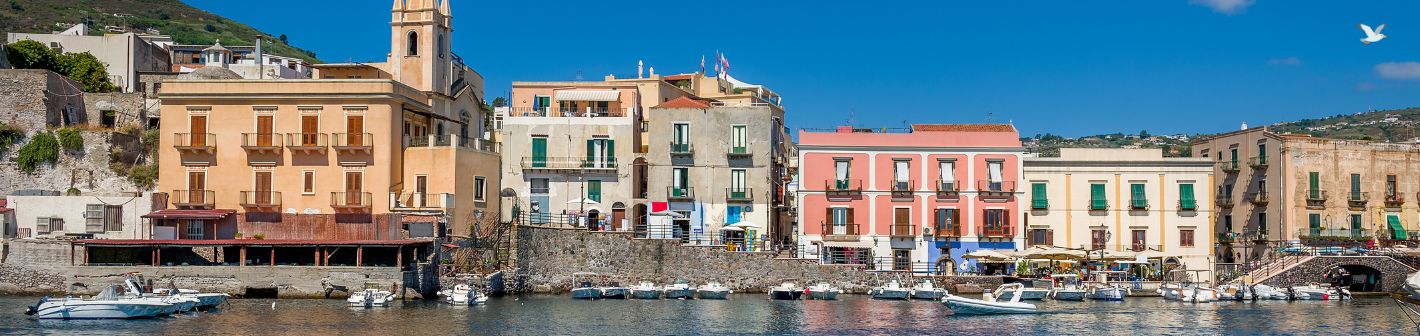
Lipari in one sentence: the largest and best-developed of the Aeolian Islands (Province of Messina) – with a lively main town, an imposing castle with its acropolis and the Aeolian Archaeological Museum, traces of pumice and obsidian history, and bays for swimming. Ideal as a base for island hopping around the archipelago – less so for anyone expecting deserted Caribbean-style beaches or guaranteed timetables. Plan on two to three days for the island and its excursions. Getting there is by sea – ferries and hydrofoils are dependent on weather and sea conditions.
At around 37 km², Lipari is the largest of the seven Aeolian Islands (Isole Eolie) off the northeastern coast of Sicily, and belongs to the Province of Messina. The volcanic archipelago has been a UNESCO World Heritage Site since 2000. Unlike its smaller sister islands, Lipari offers a certain level of infrastructure year-round – with shops, restaurants and a lively port town that is also the archipelago’s central ferry hub.
The main town, also called Lipari, is overlooked by a rocky plateau on which the castle stands, along with the ancient acropolis and the Aeolian Archaeological Museum. The island’s history is shaped by mining: for centuries, pumice (pomice) was quarried and traded here, and in prehistoric times obsidian – the pale pumice quarries in the northeast still define the landscape today.
Lipari has no extensive sandy beaches, but mostly pebble and rocky coves, often with clear water. The island’s real strength is its location: from here you can reach the neighbouring islands by boat – from smoking Stromboli, to fashionable Panarea, to sulphurous Vulcano. Anyone planning to island-hop should factor in the dependence on weather from the outset.
Quick facts
- Location Largest of the Aeolian Islands (Isole Eolie), Province of Messina, northeast of Sicily
- Length of stay 2–3 days for the island and excursions; more as a base for island hopping
- Car largely unnecessary on the island; vehicle restrictions in summer, buses & scooters as an alternative
- Getting there by sea only – ferry/hydrofoil mainly from Milazzo (Sicily); dependent on weather and sea conditions
- Best time May–June and September; high summer is crowded and hot, winter has reduced ferry services
- Who it suits island hoppers, culture and beach visitors; less so for sandy-beach purists
- Highlights castle/acropolis, Aeolian Archaeological Museum, pumice quarries, coves
- UNESCO Aeolian Islands (World Heritage since 2000)
Who is Lipari worth it for? (Decision helper)
| Traveller type | Well suited | Limitations |
|---|---|---|
| Island hoppers | central ferry hub to all Aeolian Islands | connections weather-dependent – onward links not guaranteed |
| Culture & history | castle, acropolis, Aeolian Archaeological Museum | climb up to the castle, heat in summer months |
| Beach visitors | clear pebble and rocky coves, boat trips | hardly any real sandy beaches, some reachable only by boat |
| Seeking peace and quiet | quiet and relaxed in the off-season | main town very lively in summer |
| Without a car | main town on foot, island buses, boats | remote coves hard to reach without your own vehicle/boat |
Top sights (with time needed & admission)
The main town is explored on foot; the castle is reached via ramps and steps. The table below gives the realistic time needed for each destination and, where applicable, a note on admission. All figures are approximate (as of 19 June 2026) and should be checked before your visit.
| Destination | Time / admission | Tip |
|---|---|---|
| Castle & acropolis | 1–2 hrs · partly admission | fortified rocky plateau above the harbour; ancient and Baroque layers |
| Aeolian Archaeological Museum | 1.5–2 hrs · admission | one of the most important collections on the islands’ history; within the castle grounds |
| Old town & Corso Vittorio Emanuele | 1 hr · free | main street with shops, cafés and restaurants |
| Pumice quarries & Belvedere Quattrocchi | 1–2 hrs · free | viewpoint overlooking the Faraglioni and Vulcano |
| Coves (e.g. Valle Muria, Spiaggia Bianca) | half a day · free | some reachable only by boat/bus; sturdy footwear for pebble beaches |
Opening hours and admission prices (e.g. for the museum and castle areas) are approximate (as of 19 June 2026) and should be checked before your visit.
Highlights in detail
Castle & acropolis
The castle of Lipari sits enthroned on a rocky plateau above the harbour and is the historical heart of the island. Its grounds hold the ancient acropolis, where layers of settlement from the Bronze Age through the Greek and Roman periods to the Middle Ages and the Spanish era can be traced. Within the walls stand churches, excavation areas and the archaeological museum. The climb up the ramps and steps is manageable, but sweat-inducing in the midday heat – early morning or late afternoon are more pleasant.
Aeolian Archaeological Museum (Museo Archeologico Eoliano)
The museum within the castle grounds is considered one of the most important collections on the prehistory and early history of the Mediterranean. It displays finds from the obsidian and Bronze ages, ancient ceramics, and a well-known collection of theatre masks and vases. Anyone wanting to understand the history of the islands should allow at least an hour and a half here. The collection is spread across several pavilions – a tour is worthwhile even in bad weather.
Pumice and obsidian history
Lipari is of volcanic origin, and mining has shaped the island for millennia. As early as prehistoric times, the obsidian found here – a sharp-edged volcanic glass – was a sought-after trade good in the Mediterranean. Later, pumice was quarried on a large scale in the northeast of the island – the pale quarries and disused facilities are still visible today. Industrial pumice extraction has since been discontinued, partly in connection with the UNESCO status. Note: some old industrial areas are not open to the public or are closed off.
Coves & Belvedere Quattrocchi
Lipari has no long sandy beaches, but rather a series of pebble and rocky coves with clear water. Well-known examples include Valle Muria in the southwest and the pale Spiaggia Bianca in the north, which owes its name to pumice deposits. Many coves are most conveniently reached by boat or bus. A rewarding viewpoint is the Belvedere Quattrocchi, with views of the offshore Faraglioni rocks and the neighbouring island of Vulcano. Sturdy footwear and water shoes are useful at the pebble coves.
Day plans
| Situation | Suggestion |
|---|---|
| Half a day | Old town & Corso Vittorio Emanuele → climb up to the castle & acropolis |
| One day | morning at the castle & archaeological museum, midday break in the port town, afternoon at a cove or the Belvedere Quattrocchi |
| In hot weather | early castle & museum visit, midday shade/café, later a boat trip or a swim |
| With island hopping | day 1 Lipari, day 2 Vulcano or Salina, day 3 Stromboli/Panarea (depending on weather and connections) |
| With children | stroll around the harbour, short boat trip, manageable beach day at a quiet cove |
Getting there
Lipari is reachable only by sea – there is no airport. The main departure port is Milazzo on the north coast of Sicily; from there, ferries (slower, carry vehicles) and faster hydrofoils/catamarans (aliscafi, passengers only) run. Further seasonal connections exist from Messina and from the mainland (e.g. Naples). Anyone arriving by car usually parks in Milazzo and crosses over on foot, since a car on the island is usually more of a burden than a benefit.
Important note on ferries & connections: ferry and hydrofoil connections to the Aeolian Islands are dependent on weather and sea conditions and can be cancelled or delayed at short notice in strong winds – this applies equally to the outbound and return journey. So plan onward connections (such as a return flight from Catania or Palermo) with a generous margin, ideally with a buffer day. Timetables vary considerably by season and are reduced in winter. Don’t rely on a single late connection. Please check current times and prices directly with the shipping companies – we deliberately don’t list fixed timetables or prices here.
Overview of getting to Sicily in general: Getting to Sicily. More on the archipelago and the routes between the islands: Island hopping in Sicily.
Car, buses & mobility on the island
The main town is easy to get around on foot. For the rest of the island there are scheduled buses connecting the main villages, as well as scooter, bicycle and boat rentals. A car of your own is usually unnecessary – in summer, access and vehicle restrictions often also apply for non-residents. Anyone wanting to see coves and remote corners is often more flexible with organised boat tours or a rented dinghy than with a car. Specific restrictions and timetables change seasonally – check locally.
Island hopping from Lipari
Lipari is the central hub for trips to the other Aeolian Islands. From here, all the neighbouring islands can be reached by hydrofoil or as part of boat excursions. The overview below gives rough guidance – only the shipping companies’ up-to-date daily timetables are binding.
| Island | Character | Suitability |
|---|---|---|
| Vulcano | sulphur fields, mud bath, volcanic cone | closest neighbouring island, good as a half-day/day trip |
| Salina | the greenest island, Malvasia wine, capers | day trip for nature and enjoyment |
| Panarea | small, fashionable, yacht and nightlife scene | day trip – expensive and crowded in summer |
| Stromboli | active volcano, evening eruption watching | longer excursion – volcanic activity can limit tours |
| Filicudi & Alicudi | unspoiled, little developed | for those seeking peace and quiet – less frequent connections |
Travel times and connections depend on weather, sea conditions and season, and cannot be estimated from distance alone. In the case of Stromboli, current volcanic activity can restrict ascents and boat tours. Details and routes: Island hopping in Sicily.
Where to stay (areas)
- Lipari main town: central, everything walkable, short distance to the harbour – lively in the evenings, sometimes noisy in peak season.
- Edge of the main town/higher elevations: quieter and with views – but somewhat longer walking distances.
- Outside the town (e.g. Canneto): closer to the coves, quieter – check bus or boat connections.
Food & enjoyment
Aeolian cuisine emphasises seafood and garden produce. Typical dishes include those with fresh fish, capers (especially from the neighbouring island of Salina), sun-ripened tomatoes, and the islands’ sweet Malvasia wine. Common are pasta with fish or capers, grilled fish and simple, hearty antipasti – vegetarians are well catered for with vegetable dishes and caponata. In the port town, prices are shaped by tourism – those looking away from the main street often eat more affordably. We only give specific restaurant recommendations after editorial review.
Common mistakes
- Planning connections (e.g. a return flight) too tightly – ferries can be cancelled due to weather.
- Relying on a single late connection for the return trip.
- Bringing your own car across to the island, even though it’s barely needed there.
- Expecting long sandy beaches – Lipari mostly has pebble and rocky coves.
- Not checking timetables on the day and trusting outdated times.
- Arriving in high summer without a reservation – the islands and boats are then full.
Alternatives nearby
- Vulcano – the closest neighbouring island, with sulphur fields and a crater hike. Read more about Vulcano.
- Salina – the greenest Aeolian island, known for Malvasia wine and capers. Read more about Salina.
- Stromboli – active volcano with evening eruption watching. Read more about Stromboli.
- Messina – gateway on the Sicilian mainland, with its harbour and cathedral. Read more about Messina.
Frequently asked questions (FAQ)
How do you get to Lipari?
Lipari can only be reached by sea – there is no airport. The main departure port is Milazzo on the north coast of Sicily, from where ferries and faster hydrofoils run. Seasonally there are further connections, including from Messina and the mainland. Connections are dependent on weather and sea conditions.
Are the ferry connections reliable?
They run regularly, but are not guaranteed: in strong wind or high seas, ferries and hydrofoils can be cancelled or delayed – this applies to both the outbound and return journey. Plan onward connections with a margin and don’t rely on a single late connection. Timetables vary by season and are reduced in winter.
How much time should you plan for Lipari?
One to two days are enough for the island itself. As a base for island hopping around the Aeolian archipelago, it’s better to plan two to three days or more, also to absorb any weather-related cancellations.
Do you need a car on Lipari?
Usually not. The main town can be explored on foot, and there are scheduled buses as well as scooter, bicycle and boat rentals. Vehicle restrictions often apply in summer. For coves and remote corners, boats are often more flexible than a car.
Does Lipari have nice beaches?
Lipari mostly has pebble and rocky coves with clear water, not long sandy beaches. Well-known examples include Valle Muria and the pale Spiaggia Bianca. Many coves are best reached by boat or bus – water shoes are useful.
Plan your Lipari trip
Combine Lipari with the Aeolian Islands
Our travel agency puts together a route through the Aeolian archipelago for you – with accommodation in the right location, ferry and boat connections with a realistic time buffer, and sensible stages. Just send us a no-obligation travel request.
Further reading
- Province of Messina · Messina · Island hopping in Sicily
- Getting to Sicily · Best time to visit
- Beaches in Sicily
Last updated: 19 June 2026. Timetables, opening hours, admission prices and transport options are time-dependent and should be checked before your trip. Ferry and hydrofoil connections depend on weather and sea conditions – we deliberately don’t list fixed timetables or prices. Sources: UNESCO (Aeolian Islands), general knowledge of the region – for up-to-date connections, check with the respective shipping companies.

